• Skip to main content

Rachael Herron

(R.H. Herron)

  • Blog
  • Books
  • Bio/Faq
  • Subscribe
  • For Writers
  • Podcast
  • Patreon essays

Rachael

Ep. 183: Jennie Nash on Harnessing the Power of Jealousy

August 3, 2020

Jennie Nash is the founder of Author Accelerator, a business that has trained more than 50 book coaches to support writers through the entire creative process of completing a book. Jennie started her career on staff at Random House and has spent 30 years on all sides of the publishing industry. In her time as a book coach, her clients have landed top New York agents and book deals with houses such as Scribner, Simon & Schuster, and Hachette. Jennie is the author of 9 books, 5 of which were published by Big 5 publishers. She has taught for 12 years in the UCLA Extension Writer’s Program and spoken at writing conferences all over the country. Her guest posts have appeared on popular writing sites including The Write Life, Writers Helping Writers, and The Book Designer.

Show link: Go visit Jennie for the free goodies at https://www.authoraccelerator.com/rachael

How Do You Write Podcast: Explore the processes of working writers with bestselling author Rachael Herron. Want tips on how to write the book you long to finish? Here you’ll gain insight from other writers on how to get in the chair, tricks to stay in it, and inspiration to get your own words flowing.
Transcript

Rachael Herron: [00:00:00] Welcome to “How do you Write?” I’m your host, Rachael Herron. On this podcast, I talk to authors about how they write, what their process is and how their lives fit together. I’ll keep each episode short so you can get back to writing.

Well, Hello writers! Welcome to episode #183 of “How do you Write?” I’m Rachael Herron.

[00:00:22] So pleased that you’re here with me today. Today, I have a super exciting and vibrant conversation with my new best friend, Jennie Nash, who is a force in the publishing industry. She’s a force as a writer. She’s a force as a book coach. And also, we just found out that while we were talking, we were basically the same person in different bodies in different locations. And, it was- sometimes I run into people like that. I’m like, oh no, that’s no, but with her, I was just delighted to see perhaps some of my best qualities are reflected back at me. Instead of those people that you meet, where you’re like, “Oh God, I am like that. Ah, crap.” Jennie is not that. Jennie is gorgeous, wonderful, awesome. You’re gonna love listening to her. 

[00:01:11] So we’ll get into that in a moment, a little bit of a catch up around here. I am far behind. I’m not- yeah, I’m pretty far behind. I got my revision letter back, I told you that. And then I have just proceeded to screw off. I, I am so talented at knowing at a very visceral subconscious level, the very last moment I can have before hitting a point where I won’t make that deadline if I don’t work hard. And for some reason I always walk right up to it, even when I am trying not to, even when I’m trying to get all the words done ahead of time, I still can push a deadline to its max. So I think I’ve got like 15 more days for this editor’s revision, and this is the big one. This is, you know, the take it apart again and put it back together in a different way. I am making it less emotional and more stabby, more tension, more thriller. So I keep forgetting that I keep having them have these beautiful, emotional, poignant moments between the women in this story. And then I’m like, no, it’s gotta be scary. It’s gotta be scary externally, not just deep and scary inside the heart, it’s gotta be both. So I’m trying to get all of that done and it’s not easy, but I’m trying. Everything else is going very well. It just, I just, I’m still liking this staying at home thing and I, I do admit it. I really like it. I just had a thought today that if and when the world goes, it’ll never go back to normal, but when it opens up more and we are able to see people, I think I’m going to restrict myself to seeing people once a week, that will make me choose very carefully, who I see. And when I see them back in the old days, I would usually have four to seven gatherings of some sort. I have a lot of friends and I really love them. But I can get a lot of that socializing through email, through texts, through phone calls, through Markopolos. Markopolos is an app I really like, and I don’t always need in person. I really like this expansive time to stay at home and work and work in the garden and read books. And I’m, I don’t know, that might be a rule I put down. I want to see people, but I want to keep it more limited than I was. I want more boundaries when we come out of this, I want more ability to say no to the things that don’t matter as much and always saying yes to the things that matter most, that is my goal. I don’t know how that’s going to shake out, but that’s, that’s my goal. 

[00:04:09] Another thing that has hit me is another book, another book has hit me over the head. I have been trying to figure out how to tell the story about recovery from addiction. Everybody’s got a story about recovery from addiction, you know that. So I want this one to be a little bit different and I think I may, last night, have kind of cracked the spine of it, figured out what I want it to be. Which is more than just about addiction. It’s really about living genuinely and with full acceptance of who you are at this moment without trying to change because I really do believe that I am everything I need to be right now. I believe that you are everything you need to be right now. Any of us having more of things is not going to change who we are and it’s not going to change our happiness level. Probably there’s definitely exceptions to all of this if you’re living at or below the poverty line. Yeah. Having more money will help, but we all know that study that if you make more than $73,000 a year or something like that, you can’t get happier with money. Money will not make you any happier. It’s, yeah. So this one I’m thinking about a new book somewhere around those ideas. So I’m playing with that, and I don’t know where it will fit into my life. I still want to write that women’s fiction next. I just kind of feel very much like writing all the time, right now. That’s something that quarantine has given me. I haven’t felt this way in a really long time that every spare moment I want to be writing that is not like me. I have started journaling again in a really big, deep way and I realized that I usually only journal really deeply journal when I’m traveling and, and we’re traveling right now. This is a unique experience for everybody on the globe. And it does feel like some kind of a journey and I’m very, very drawn to capturing what’s going on around me. Not for any reason, not to package up and sell, just because I need to get these words out of my mind and onto the page. So I was actually talking to Jeff Adams of Jeff and Will, the other day. He’s going to be guest hosting with me on the Writers’ Well, next week. And he showed me his record book that is not as dirty as it came out of my mouth but do you have a record book? I want to know. I ordered one, they’re like $30 and it’s, you can save your digital handwriting. I really liked journaling and then I’m always like, I’m never gonna see this book again, but if it’s online as well, that’s like a double backup. Not like anybody ever wants to read my journal, even myself, but I do like thinking about it being backed up. So I ordered a record book and that should be fun to play with. 

[00:07:08] Wow. I am just going kind of all over the place today. What other all over the place should I tell you about? I think that’s about it. I would love to say thanks some new patrons, because it has been a while since I remembered to do this. So this is going back like more than month. Thomas Makanen, it is always wonderful to have you as a patron. That’s awesome. Amanda, thank you. Oh, maybe I have to thank these people. Cause I remember thanking Amanda. Amanda, you’re the best. Janine Gurman for editing your pledge up. Thank you. Thank you. Thank you. Thank you. Everybody who is supposed to get those texts from me, I am over the limit for the text service and I’m trying to find a different service. So if you’re not getting that, don’t worry. I’m trying to fix it. A new patron, Megan Kroll and Jennifer Harris and Jill and Naomi Stenberg. Thank you. Thank you. Thank you so much to all of you. It really is and makes the difference in my being able to write those essays from which come these book ideas and whole books. 

[00:08:15] So if you would like to check out any of those essays on living the creative life, you can always go to patreon.com/rachael R, A, C, H, A, E, L, and check those out. And I really, really, really appreciate you. That’s caught up. My desk is covered in Tootsie roll pops because apparently this revision is taking Tootsie roll pops. If Tootsie roll pop is not in my mouth, I am not revising. And that’s the way it’s going to be. And I like it. And yes, let’s jump into the interview now with Jennie Nash. I know you’re going to enjoy it. Please, please get some of your own writing done and find me anywhere online and tell me about it. I love hearing about it and I believe in you. Okay, happy writing. 

[00:09:04] Hey, do you want to do more writing? on Zoom with a group of people that you like? Well, you should join rachaelsayswrite. We write together on Tuesday mornings from 5:00 to 7:00 AM Pacific standard time, 8:00 to 10:00 AM Eastern standard time. This one works for you, Europeans. And on Thursdays from 4:00 to 6:00 PM Pacific standard time, 7:00 to 9:00 Eastern standard time, New Zealand and Australia, this one’s for you. And for just $39 a month, you can write with us in Zoom. It’s like 16 hours for a month, it’s like $2 an hour to sit in a Zoom room with really cool people and spy on them while they’re writing and let them spy on you while you’re writing, they’ll get to see your true writer space and there is nothing more intimate than that. Honestly, you guys, it’s such a good time. Go to rachaelherron.com/write or rachaelsayswrite to find out more about joining. 

Rachael Herron: [00:10:03] Well, I could not be more pleased today to welcome to the show, Jennie Nash. Hi Jennie! How are you?

Jennie Nash: [00:10:09] I’m so happy to be here. I’m well, thank you. 

Rachael Herron: [00:10:12] Good. Let me give you a little introduction so we can talk about all the things you do. Jennie Nash is the founder of Author Accelerator, a business that has trained more than 50 book coaches to support writers through the entire creative process of completing a book. Jennie started her career on staff at Random House and has spent 30 years on all sides of the publishing industry. In her time as a book coach, her clients have landed top New York agents and book deals with houses such as Scribner, Simon & Schuster, and Hachette. Jennie is the author of 9 books, 5 of which were published by Big 5 publishers. She has taught for 12 years in the UCLA Extension Writer’s Program and spoken at writing conferences all over the country. Her guest posts have appeared on popular writing sites including The Write Life, Writers Helping Writers, and The Book Designer. And just before we got on there, we were kind of telling each other how nice it is to talk to somebody else who does all of the things. You do all of the things-

Jennie Nash: [00:11:10] Yeah

Rachael Herron: [00:11:11] like I do. I teach at the Accenture programs at Berkeley and Stanford and what else was I gonna say? Oh, I was looking at your book roster. You write all the genres, you write women’s fiction and memoir and nonfiction about writing that and I’ve heard your name for so long in the publishing industry, which is why I’m so excited to have you on the show because they do get people who want to be on the show because they have written a book about writing, but they have no other books, you know, 

Jennie Nash: [00:11:39] Yeah

Rachael Herron: [00:11:40] When you run into those people and you are this book coach among, you know, you’re the book coach of the book coaches, because you know how to write, because you’ve done all this stuff, which is why I’m so happy to have you on the show about process, how let’s just open it way up. How do you do it all? You have children, you have family. I just have a wife and no kids. So how do you do it?

Jennie Nash: [00:12:02] Well, my kids are grown, so it doesn’t count. I mean, I just kind of work like a dog. That’s the honest truth of it. I just do I work all the time. I-I, people sometimes say like, are you, do you have super powers? And it’s like, no, I just work all the time. And that, you know, there’s upsides to that and downsides to that, which we could talk about. But I, I just kind of refuse to give up anything. I want to do all the things I’m just greedy. 

Rachael Herron: [00:12:30] I might just take this and we’ve got the questions I always ask. But I might wanna go a little freeform with this too. What do you give up when you have to give something up?

Jennie Nash: [00:12:41] I mean the honest truth is I will give up my health. I will, I will give up myself too. I get migraines and I will hurt myself

Rachael Herron: [00:12:51] Me too! 

Jennie Nash: [00:12:52] Stop it!

Rachael Herron: [00:12:53] I know that I am working too hard when a migraine knocks me all the way to that’s how I go out. I work until a migraine knocks me to the ground. Yeah. 

Jennie Nash: [00:13:00] Okay. So you know what I’m talking about? Like a migraine is not just, I’m going to take some Advil 

Rachael Herron: [00:13:06] Oh no

Jennie Nash: [00:13:07] and feel better. Migraine is like, yeah. It’s like, you have to get under the covers in darkness and not have anyone speak to you and you can’t eat and you can’t

Rachael Herron: [00:13:17] Yep

Jennie Nash: [00:13:18] listen to anything and you’re out. And yeah. So I tell my body’s dead and it’s not something I recommend 

Rachael Herron: [00:13:26] strangely enough.

Jennie Nash: [00:13:30] But that’s the truth of it. And, and I’m trying, I mean, I’ve had them for 28 years. So when I say I’m trying, it’s not a new thing, but it’s, it’s, I love to work. I like to card, I don’t want to give up, like you said, what do you give up? And I say the trainers all the time, what are you going to give up? Because you can’t have a clean house and, you know, make perfect meals and do all the things and have time to write. And so I’m constantly helping them make those choices. And then I don’t actually make them my own self. I just try to do it all. 

Rachael Herron: [00:14:03] I think you may be my new favorite person and my, my, my twin and soul, because that is what I do. I tell everybody to give up something and I don’t give up anything. And that does come at the expense of my own health and snapping at my wife, for example, you know, she’ll get the short end of the stick right there. Yeah, 

Jennie Nash: [00:14:24] Yeah, yeah. 

Rachael Herron: [00:14:26] Yeah. She, she adores that when I’m like on deadline and starting through classes like I was last week, so. Well,

Jennie Nash: [00:14:28] That’s interesting so that’s the thing you give up is like peace in your home. And I would do the same thing. I would yell and snap at the people I love. And, and-

Rachael Herron: [00:14:36] And then I would-

Jennie Nash: [00:14:37] Yeah, it’s not okay. 

Rachael Herron: [00:14:39] It’s not okay. And then I blame it on how busy I am. And she always says, whose fault is that? And she’s

Jennie Nash: [00:14:47] Oh my gosh. My, my daughter who’s teaching seventh grade is living with me right now in this shutdown. And we have a little snippy fight recently because she was like, I just, I just gotta get to June 15th. Cause then they have summer teachers have summer and look, teachers work so hard. I’m not even kidding how hard she works. It’s relentless, like every day and it’s just, you’re in it and you’re in it and it’s horrible. And, but she said summer, and I said something like, well, at least you get it. And, and she just looked at me and she said, you could have a summer if you wanted mom as like, you know, like, I can’t like, I don’t- a rules don’t apply to me. I’ve could, I could work a straight that I’m in charge of my own destiny, but I don’t 

Rachael Herron: [00:15:35] Not, not that I buy into any of this stuff, but what is your star sign? What is your astrological? 

Jennie Nash: [00:15:40] Oh, Gemini. 

Rachael Herron: [00:15:41] Oh, okay. I’m a cancer. All right. At least we don’t have that, at least we can’t blame it all on something other worldly. So, so when you are writing your own books and when you’re not coaching, what is your writing process? What does that look like? 

Jennie Nash: [00:15:51] So I don’t have a habitual practice, I write in bursts and I write in fits and starts. And I kind of, it’s almost like fever, fever writing. So I, it’s hard for me to say exactly when I do it, or, but I love writing at night. I love writing late at night and I love writing like Saturday morning is the dream when nobody’s going to email or text or call or knock on my door or ask me anything. So I like to get up early and write and like to stay up late and write. And it’s all about just avoiding the, the wave of demands. 

Rachael Herron: [00:16:32] I don’t think I’ve ever heard anybody say that so concretely, but Saturday morning is a delight to work. That is so, so true.

Jennie Nash: [00:16:40] Right?

Rachael Herron: [00:16:41] Yeah. I hadn’t actually, I usually try not to, but yeah. 

Jennie Nash: [00:16:45] Well, I love, another thing I always tell my writers that I don’t do, is I’m saying there’s no cabin in the woods. And by that, I mean, you’re not going to get the fellowship where they bring you lunch in a basket and you go off the grid for three months. And you get to write your book and, and you do it in three months. Like that’s not happening for you, that you have to make your own time in your own life and your own way. I’m always saying that and talking about that. And yet the way I write best is when I get those kind of clearings, you know, this kind of like white space on the calendar, I’ll, I’ll be like, Ooh, and I can dive in and, and write it. But I, I’m really bad at actually blocking that time. And I, and I like would like to be better, 

Rachael Herron: [00:17:35] But the thing is, I’m going to push back on that just a little bit, is that your process works and you’re getting books done 

Jennie Nash: [00:17:41] Yeah

Rachael Herron: [00:17:42] and you are making, you would like a cabin in the woods when we all, and you make that in the white space on your calendar. Whereas for white space, for me, doesn’t work personally, because then I go watch Netflix or garden or something. I do anything, but write. So it works for you. Your method has worked.

Jennie Nash: [00:17:56] It does, it does work for me. And I’ve actually really deeply loved the shutdown because I- oh you have?

Rachael Herron: [00:18:05] I’m passionate about it. I don’t ever want it to change. I hate it for how bad it is. I hate everything about it for medically and all that. But yeah, 

Jennie Nash: [00:18:14] I- I’m sad we have to go back because what I realized is that the, the energy, the calendar energy, I call it. So like, are you free on Saturday night? Can you come at 6? Should we do it at 7? I don’t know. Maybe we should do it Sunday night. Like that, just that energy or, Ooh, the person I want to hear in concert is coming. How much are the tickets should we do with the balcony? Or should we do the thing? And should we go like. I love that all being out of my life. And I’m 

Jennie Nash: [00:18:41] Yeah

Rachael Herron: [00:18:42] And I – Right? That’s social energy. I mean, I love my friends and my family and, and all of it, but I, and what I find is that I am so eager to work that I’m like, if I get to an evening and there’s nothing to, that we have to go do, or that we’re plan to go do, I just want to work. So I, I it’s weird how much I like it. 

Rachael Herron: [00:19:11] I like most of my parts of my job, except for first drafts. I really, I struggled with the first draft or are you a first drafter or are you more of a reviser? Are you in all things? 

Jennie Nash: [00:19:21] I like all the things. I mean, I, I like all of the things I, I draft really quickly. I, I revise really intentionally. I like, I like all the, I like all the things I do. I do.

Rachael Herron: [00:19:37] and that makes you a perfect book coach of book coaches. What is, what is your biggest challenge then when it comes to writing? 

Jennie Nash: [00:19:48] Gosh. Really it’s just finding the time. I mean, I mean, with the writing itself, I- I’ve taught writing so much and I help people so much. I think I’ve internalized a lot of the things that, you know, it’s like the things I help other people with that they don’t do well is putting boundaries around your idea, really defining what that idea is going to be. Maybe saving that for another book or maybe saving that taken out subplot out cause it doesn’t fit, or like the structural decision-making and the shape, the shape of things. I have so many of those conversations all the time. I think I’ve internalized internalize those. So when I sit down to write, I tend to, I tend to just be, know what to do. 

Rachael Herron: [00:20:36] That’s a good feeling. 

Jennie Nash: [00:20:39] It’s such a good feeling. 

Rachael Herron: [00:20:40] Yeah. 

Jennie Nash: [00:20:41] It’s, it’s such a good feeling. I find such enormous peace in the writing process. I feel like, feel like I recognize my voice that’s been with me my whole life and it felt like coming home and it, it just feels like, Oh, here, here I am. You know, and that’s my favorite part of it. So the challenge is that part of it is so strong that the challenge has almost don’t matter cause I want to get to that feeling 

Rachael Herron: [00:21:12] That is gorgeous. What is your biggest joy when it comes to writing then? It sounds like you have a lot of joys to choose from 

Jennie Nash: [00:21:20] I mean, it’s that, it’s that. It’s that coming home. It’s like, here I am. This is me. I’m, I’m, I’m in it. And even if I have 10 minutes to write something I can get into that space and it feels wholly my own. I mean that, that’s the thing about writing, right? We’re in charge. We were the ones or the boss. 

Rachael Herron: [00:21:42] Is there a genre that you feel more at home? And for me, I sink into my bones, even in first drafts I love being inside my body when I’m writing a memoir or creative nonfiction of any sort. Fiction, I struggle more with first drafts, but is there a genre that you feel most at home in?

Jennie Nash: [00:21:59] I would say that it is memoir as well. And I- I’ve had an interesting experience with my newsletter, I, for a long time doing it for a long time. And I have a pretty nice following and I used to be super craft-based as I can, all the craft lessons and all the how to’s and you know, strategy. And, and then I started paying attention to what people liked, imagine that, and every time I would write something. It was usually when I was laid on my deadline as, and I just had to whip something out and I just write some dumb thing in my mind about whatever, what I made for dinner or one of my kids or, you know, something people love them. And so more and more, I’ve just done that for that weekly thing. And it’s, it’s just- it’s, it’s just, there’s nothing like it. It’s so fun. Just writing about my own self and what I think.

Rachael Herron: [00:22:59] Right? It’s-

Jennie Nash: [00:23:02] Don’t you think?

Rachael Herron: [00:23:03] I really do. And I don’t know if you’re like me though, but honestly, you know we’re j- we’re joking about it, but, but I don’t really know what I think about things, until I put them on the page and explored them and written around them. And gotten to what I know. And I don’t know, I usually don’t know when I sit down, when I start writing about something, you know, I wrote something last night in my journal that has freaked me out and I’m like, Oh God, am I going to have to like, go there? Now do I have to go there? That I’ve said it. You know.

Jennie Nash: [00:23:32] Oh, see, that’s amazing. And, and yeah, I agree with that. That they’re it’s regulatory, but it’s also, you, you own it. There’s this authority like it’s so just you it’s a whole it’s, it’s yeah, I, I really it’s easy for me. All the other writing is harder. Yeah.

Rachael Herron: [00:23:54] Oh, that’s so cool. Okay. So what oh, no. First of all, can you share a craft tip? Speaking of craft, with our listeners? 

Jennie Nash: [00:24:04] Yeah. I’m going to talk about revision, 

Rachael Herron: [00:24:06] Yey!

Jennie Nash: [00:24:07] By thinking love revision. Do you like revision?

Rachael Herron: [00:24:11] The best. I, the only reason I write is to get back into revision because I can write, I can revise 12 hours a day. I’m in heaven. I can’t stop. 

Jennie Nash: [00:24:18] Right? It’s so much fun. And it’s where the thing because becomes what it wants to be. 

Rachael Herron: [00:24:24] Yes

Jennie Nash: [00:24:25] And so I love revision and I know a lot of people don’t like to talk about revision. And the thing the tip- the tip I would have to be, don’t revise in the same way you wrote. You have to do it in a different mind space, and that can be, you can do that physically, like you could do it in a different place than you write. You could, even just changing the font on your, on your main script or printing it out in a different font, and it falls on the page differently. Can put your- can make you just shift how you’re looking at it. And the whole thing that an editor does, you know, the joy of being edited is somebody else’s eyes around on your work and they’re bringing a different perspective to your work. So if you can do that for yourself, like get out of your head you wrote in, and look at it in a, just a different angle, a different way, a different viewpoint, you know, really trying to get a 360 view point on it. That’s the trick; is don’t just go to- the mistake I see so many people make is they think revision, well, there’s two things. I think revision is mine editing. 

Rachael Herron: [00:25:32] Yeah

Jennie Nash: [00:25:33] They think it’s fiddly little word- wordsmithing, and it, it’s not, it’s heavy lifting earth moving, you know? And then the second mistake they make is they just fall into that same rhythm or pattern that they did when they were writing. And then they, I’m sure you do this. I, this always cracks me up when I’m, when I’m reading my own stuff and you get into that thing, you’re like, Oh, this is good. Right? You’re just doing what you do when you write. Cause when you’re writing and you think that you don’t have to work on that. 

Rachael Herron: [00:26:09] Exactly

Jennie Nash: [00:26:10] So then you work on the next revision. So,

Rachael Herron: [00:26:12] Yeah I love that feeling, but that is one of the warning signs for me, in like a second draft or a third draft. If I’m really loving it, I have to pull back out of it. Like there’s something I might not be seeing yet in a fourth draft or a fifth draft, you might let yourself, you know, enjoy that little bit.

Jennie Nash: [00:26:28] Yeah, it’s take your writer’s hat off. Like literally I’m not a writer right now. I’m, I’m an editor I’m trying to be in my readers’ shoes. I’m trying to look at this from the outside. I’m trying to be analytic instead of, you know, creative just different perspective will make your revision process so much better. 

Rachael Herron: [00:26:50] I love that. Thank you so, so much. And thank you for being on my side for revision. It’s magic, literally the magic of writing. So what thing in your life affects your writing in a surprising way?

Jennie Nash: [00:27:04] Oh, my gosh, I love this question so much because I have to answer the real thing and the real first thought I’m like, 

Rachael Herron: [00:27:10] Oh good. Good.

Jennie Nash: [00:27:04] When I first thought of it, I’m like oh, I don’t have to actually really answer it. The surprising thing that I find really motivating is jealousy. 

Rachael Herron: [00:27:24] Oh! Tell me more. 

Jennie Nash: [00:27:26] I get so jealous. I get so jealous of everyone and everything for every reason you could possibly name. And I, and it’s not just a little jealous, it’s like rage. I’m like, I’m like rage jealous and it can just be like, if I read something I love and I’m just like, Oh, so good. And, and then I think I wish I had that idea

Rachael Herron: [00:27:51] Yes

Jennie Nash: [00:27:52] Like as if you could just take someone else’s idea or, you know, if somebody has a big success and, or some big lucky break, and I’ll think I could do that if I just had a lucky Bree, you know, like but I’ll, I’ll I think I even get jealous of my students that I teach. Like if they’re doing really well, I’ll get jealous of them. It’s bizarre. But I find it super motivating. 

Rachael Herron: [00:28:22] I love that. I love that you’re talking about it because people don’t talk about it. It is one of those guilty things to be hidden away. Like we shouldn’t have jealousies. I just ranked low on the jealousy scale as a human being anyway. But the places where I find jealousy the most painful is when I am reading something that I know I couldn’t write because I’m not that writer. And I’m just so mad at myself 

Jennie Nash: [00:28:48] Or like or I’m not that good. 

Rachael Herron: [00:28:51] I’m not that good at that. Oh yeah. I have it 

Jennie Nash: [00:28:53] Yeah

Rachael Herron: [00:28:54] all the time.

Jennie Nash: [00:28:56] Like I’m not that smart.

Rachael Herron: [00:28:57] Yeah

Jennie Nash: [00:28:58] I’m not that smart. I couldn’t have pulled that off. 

Rachael Herron: [00:29:00] That’s actually one of my biggest ones, is I’m not that smart. Like 

Jennie Nash: [00:28:04] Yeah

Rachael Herron: [00:29:05] I’m working on finishing up a thriller right now. But I’m letting myself read thrillers, which is not a good idea. And all of the twists that are coming on, I’m like, I can’t do that. I can’t do my twists are stupid. 

Jennie Nash: [00:29:13] Right. Right.

Rachael Herron: [00:29:16] Yeah. 

Jennie Nash: [00:29:17] They’re all those, right. Yeah. Yeah. I feel that I feel that a lot that I’m, I’m not that smarter. I’m not that- it’s strange. It’s just a strange thing that I feel like I have no outside reason, external reason, no demonstrable reason that I should feel jealous. And I do well at what I do. And I’m successful in all things, but I, that’s what I feel. 

Rachael Herron: [00:29:47] And instead of using it, instead of turning it into an opportunity for self-pity and getting into bed and pulling the covers over her head, which I’m also good at, you said you use it to motivate yourself. How, what does that look like? Does it mean, I’m just going to work that much harder?

Jennie Nash: [00:30:01] I mean, sadly, yeah. 

Rachael Herron: [00:30:02] Yeah, that’s great!

Jennie Nash: [00:30:04] I think that’s part of what drives, what the drive is, comes from is I’ll get angry or mad or jealous or needy or whatever the jealousy feels like. And, and then I’ll say, well I’ll show them or paying any attention to me, right. Or like, yeah. Like I’ll, I’m going to just work that much harder or apply myself that much more. So it, it gets me like that’s fire fuel for the fire.

Rachael Herron: [00:30:32] You’re harnessing it. You’re not just letting it be a distracting emotion and you’re actually harnessing it. And I really, really 

Jennie Nash: [00:30:39] Yeah

Rachael Herron: [00:30:40] love hearing that. Oh, my gosh. I think,

Jennie Nash: [00:30:42] Yeah

Rachael Herron: [00:30:43] I think I could talk to you all day about everything and I’m immediately signing up for your email newsletter, by the way. I know that 

Jennie Nash: [00:30:50] Oh no. Now you’re gonna be like, wow, she just chit-chats about her

Rachael Herron: [00:30:54] That’s all I do. And that’s what people love the best is when they talk, when people love talking about their real lives and fantastic. Okay. So what is the best book that you’ve read recently? And why did you love it? 

Jennie Nash: [00:31:07] So I tend to be behind everybody else because I read all day and I work with words all day. So I read very, very slowly. I love to read, but I, I’m always way behind. And I’ll say to people all the time, like, Oh, did you read whatever? And they look at me like, yeah, before the movie came out and I’m like, Oh, there was.

Rachael Herron: [00:31:27] I did that the other day. And they’re like the one that won the Pulitzer? Yeah. I read that five years ago. Exactly what happened, 

Jennie Nash: [00:31:37] Well I would just thread it like the way my mind was Daisy Jones in the sixth. Oh my gosh you don’t –

Rachael Herron: [00:31:45] I read it. I think I have on my list, but what did you love about it?

Jennie Nash: [00:31:49] Okay, it is just the most mind blowing thing. It’s Taylor Jenkins read and she basically recreated the story of Fleetwood Mac.

Rachael Herron: [00:31:58] Okay, so you’re saying, some kind of musician, right?

Jennie Nash: [00:32:02] Rock and roll, opera kind of thing. But the thing that just was extraordinary about it was he chose the structure that is the band members are telling an oral history of the band. So it’s a fake band and they’re telling fake oral history of the band. So that each band member it’s like six or seven or eight or 10, there’s a lot of characters. And there, they’re speaking to a, invisible host basically. I’m like a,

Rachael Herron: [00:32:31] like a reporter? 

Jennie Nash: [00:32:32] Yeah. 

Rachael Herron: [00:32:33] Oh okay

Jennie Nash: [00:32:34] And so there, there’s this weird perspective that talking at you, but you’re not who they’re talking to, but they- that’s the thing that I’m just like, I could never pull this off. Like it’s just extraordinary. And each voice is super distinct, but what’s just amazing about it is that they all contradict each other all the time. It’s like, it’s like, Oh, remember that show in Oslo where whatever happened? Oh no, that wasn’t Oslo. That was Berlin. Oh yeah. Remember in Mexico. And that happened and they’re telling the same thing and they’ve all got it wrong. And you’re just it’s so it’s like this. Edit page truth, that there is no truth and there is no memory, it’s just extraordinary and 

Rachael Herron: [00:33:19] That sounds gorgeous.  

Jennie Nash: [00:33:21] It’s beautiful. And that you think, you know what it’s about because it’s, it’s like this Stevie Nicks characters at the center. And, and you think, you know, it’s like a rise and fall to fame, you think, okay, I got this, but it turns out really not to be that, it’s about something else. And that’s something else that emerges while the story unfolds. And he kind of begins to tickle in the back of your mind. And then it comes super clear at the end, what it, what it was really about and like a twist to it. And it- it’s just, it’s just masterful. I just cannot, I’m just obsessed with it. 

Rachael Herron: [00:33:53] I am going to read it cause it’s either in this stack right here, or it’s on my Kindle in my TBR pile. But I will confess to you since we are being so open and honest with each other while you were talking about it, I felt an identified a twinge of, Oh, that’s a great framing device. I could never have thought of that framing device, you know? 

Jennie Nash: [00:34:13] Right. That’s exactly it. And, and people underestimate the power of structure 

Rachael Herron: [00:34:20] Yes

Jennie Nash: [00:34:21] of how you’re going to paint this material. So here’s this idea like I, and I, and after I read it, I do this one I’m obsessed with something. I go read everything about it. Like all the interviews. And all the things and, and Reese Witherspoon actually did buy the movie, right? 

Rachael Herron: [00:34:35] Of course she did. Cause she’s so buying the best stuff.

Jennie Nash: [00:34:41] Right, and somebody is gonna write the music that’s fake music for this fake band, which like, do you love that? 

Rachael Herron: [00:34:46] I’m actually in a yacht rock band called Sausalito. So I sing a lot of Fleetwood masks. So I’m definitely on board for this entire entirely. 

Jennie Nash: [00:34:55] Wait, I only recently learned what yacht rock was, and I was like, rock is the music of my life. And I didn’t even know it –

Rachael Herron: [00:35:05] It’s more, it is, I will say it’s more of a recent term that people have coined for that time, late seventies, like maybe into the early eighties, but it’s so good. And it’s so fun. So this book is absolutely something I must read like tonight, 

Jennie Nash: [00:35:17] Right? You have to. I mean, if you can, if you can do it, if this is your jive I would recommend the audio book. Because it’s just a tour to force. It’s just amazing. 

Rachael Herron: [00:35:29] Is it read by different characters or is it one narrator? 

Jennie Nash: [00:35:34] You know what’s weird, I can’t even tell you. I can’t even tell you. I think it must be different. It has to be different. 

Rachael Herron: [00:35:41] Interesting. 

Jennie Nash: [00:35:42] Yeah. I love it. 

Rachael Herron: [00:35:43] I have audio credits.

Jennie Nash: [00:35:45] And it was that thing you and I talked about, the whole time I was reading it it’s like you’re holding in his head, in your head, these two things at the same time, I, I love this so much and I just cannot get enough of it. It’s so great. And the experience of being in it is so amazing. And then on the other side, is that like, I could never do that. I could not have thought of that. I wouldn’t, I would have just written it straight, like straight thing. And how’d she even be so bold as to rewrite the fleet with max or like that’s pretty ballsy. Like it, there’s that chatter the whole time of, you know, underneath. Underneath it all. 

Rachael Herron: [00:36:19] What I really love about this conversation right now, is that other people who have less experience will be listening to this. And my students are always saying, I can’t believe that you have imposter syndrome or that you feel this way about your, you know, the revision letter that you just got and, you know, it’s good for everyone to know that this doesn’t go away and we use it to serve our art and to get back into try harder and never rest on those proverbial laurels. Right? 

Jennie Nash: [00:36:45] Yeah. Well, there’s a, I think there’s a lot, a lot of people believe that when they get to where you are and you know, you’ve made it in their mind because they’re just trying to get to the first rung of the ladder and you’re way up the ladder. And, but there’s really not that big difference between what you do and what they’re doing, but it just, it feels like it’s going to be different for, they think it’s going to be different when they get to where you are. 

Rachael Herron: [00:37:09] Yeah

Jennie Nash: [00:37:10] And I think there’s a lot of disappointment from people who are published as when a writer first gets published, as they realize like, Oh, it didn’t change my life. 

Rachael Herron: [00:37:20] Yeah

Jennie Nash: [00:37:21] I still am who I am. My rating is still what it is. I still feel doubt when I sit down, I still. 

Rachael Herron: [00:37:28] There’s still dishes in the sink. There’s still, you know, the whole world, like 99.9999999% of the world still hasn’t heard of you, you know? 

Jennie Nash: [00:37:37] Right, right. 

Rachael Herron: [00:37:39] Yeah

Jennie Nash: [00:37:40] Yeah. It definitely changed your life. I mean, the kind of life changing thing, you know, like a JK Rowling or seeing King, you know, that’s like the 0.01 of the.01% 

Rachael Herron: [00:37:53] Yeah. Yep. And the rest of us though, get to do this and we love what we do and we get to chat to each other about it like this, which is amazing. And now I would love to turn this over to you. What would you like to tell us about, I know you have a recent book, right? 

Jennie Nash: [00:38:08] I do. I do

Rachael Herron: [00:38:09] And tell us about Author Accelerator. Tell us where to find you. Tell us all the things. 

Jennie Nash: [00:38:15] Author Accelerator is a company on a mission to train book coaches. So we train book coaches to help writers and I’m really trying to raise the bar on this industry. Kind of what we were talking about earlier that it’s, this is hard work and it’s long, you need to commit yourself to it. And having someone in it with you by your side is, is sometimes the best way to get it done. If you’re not finding you can get it done yourself. And I’m, I sort of stand in opposition to the write fast, write a best seller overnight. You know, you can do it, you know, in 90-days kind of thing. I just, you can draft something in 90 days, a 100% and you can get an idea down whatever, but like to get from beginning to end, that’s not happening. 

Rachael Herron: [00:39:01] No. And I have students who are like, I wrote a draft and I’m going to put it on Amazon now. And I mean, you can. Go for it.

Jennie Nash: [00:39:06] Yes. 

Rachael Herron: [00:39:08] It’s not going to go well for you, but, okay. Yeah. 

Jennie Nash: [00:39:11] So that’s, I’m really trying to acknowledge and respect how hard the work is and train people to help people do that hard, hard work. So you can find us, we’ll put some special stuff for your listeners at Author Accelerator. I have to decide what it’s going to be like, your whole name, just your first name, Rachael

Rachael Herron: [00:39:30] Oh let’s just use, Rachael. Yeah. But it’s spelled, R A C H A E L. So, 

Jennie Nash: [00:39:36] So we’ll go https://www.authoraccelerator.com/rachael. Perfect. And I can put some stuff on there and some resources and things for people to, to find. And the book I just wrote is called, I laugh at the title, Read Books All Day and Get Paid For It. 

Rachael Herron: [00:39:53] It’s the best title ever. I, when I saw it, I was just like, that is one click right there. One click.

Jennie Nash: [00:40:04] Read this all day and get paid for it. That’s what we do. And this is a really nuts and bolts book about how to run a business, how to run a book coaching business. And there’s a lot in there about how to value this work because a lot of people are giving this work away for free. They’re like the most amazing critique partners on the planet. They’re the friend that everybody gives their pages to, they’re the one running the book club and they’re, they’re giving this work away for free. And I’m trying to say that work is usually valuable and you should put a price on it and you could have a side gig or a whole, whole career at that.

Rachael Herron: [00:40:42] I love that you have done that. I have actually seen some friends, like I am not an idea- idea, generator. I’m just not, but one of my best friends, Adrian Bell, she, you say, what should I do with this idea? And she, she helps you. She’s got that 30,000 footview, view, but she’s able to bring to this kind of thing and she’s monetizing it now with her plot MD and just seeing people use their skills and the fact that you’re giving this book to people who can then use their skills to get paid, for having 

Jennie Nash: [00:41:13] Yeah

Rachael Herron: [00:40:14] good sense when it comes to story structure. 

Jennie Nash: [00:41:16] And the sad reality is that it’s a creative business and it’s a very, a lot of women are in this business. And those two things together, our culture tends to devalue and it, so I’m just fighting against that, that we need to value that work that. I mean all creative work, but people who are helping creators and people who have that skill and that’s, that’s what I’m on my soap box about. And this book is a good start. 

Rachael Herron: [00:41:45] I love it. Oh my gosh. I have enjoyed this conversation so much, Jenny. I would like to sign up to be your next friend when you need one. So I’ll be there. Put me on your waiting list. I won’t, I don’t even know where you live, so I won’t bother you, but I think you’re fantastic and I really enjoy you and I loved talking to you. 

Jennie Nash: [00:42:06] Thanks a lot.

Rachael Herron: [00:42:09] Well, happy writing to you. 

Jennie Nash: [00:42:10] Thank you.

Thanks so much for joining me on this episode of “How do you Write?” You can reach me on Twitter, twitter.com/RachaelHerron, or at my website, www.rachaelherron.com, you can also support me on Patreon and get essays on living your creative life for as little as a buck an essay at www.patreon.com/rachael spelled R, A, C, H, A, E, L and do sign up for my free weekly newsletter of encouragement to writers rachaelherron.com/write/

Now, go to your desk and create your own process and get to writing my friends.
Posted by Rachael Leave a Comment

Ep. 182: How to Allow Yourself to Suck and Fix it Later

August 3, 2020

Ep. 182 Miniepisode: How to Allow Yourself to Suck and Fix it Later

It says 186, but it is actually 182!

Transcript

Rachael Herron: Welcome to “How do you Write?” I’m your host, Rachael Herron, and this is a bonus episode brought to you directly by my $5 Patreons. If you’d like me to be your mini coach for less than a large mocha Frappuccino, you can join too at www.patreon.com/rachael

Well, Hello writers! Welcome to episode #182 of “How do you Write?” I’m Rachael Herron. 

[00:00:21] Couldn’t be more pleased that you’re here with me today. Today’s a mini bonus episode smack dab in the middle of quarantine and Corona virus, here in California, we are not going to have our state home orders lifted until at least the end of May. I know that LA I’ve heard, just went to the end of June and I have to tell you I’m doing really well. I was made for this kind of life, I really was, and I don’t mind enjoying parts of it. The whole thing is so awful and tragic, that where we find happiness, I believe we deserve to find happiness. So I enjoy being here at my desk and I enjoy talking to you. And today I’m going to go through a couple of questions that I’ve had stored up. I won’t get to all of them, but I’ll try to do them soon. If you are a patron level of $5 or up, you should use me to ask questions. That’s what I’m here for, I’m your mini coach for this. 

[00:01:23] Mariah, however, just sent me an email. This is not really a question. She had a comment. After I did a mini episode, pretty recently about revisions and skeleton scenes. And it tickled me so much that I asked for her permission to share it with you here today. Mariah is the person who, four years, ago when I went full time writing more than four years now, she encouraged me to coach writers and she volunteered herself to be my first. A Guinea pig and victim. I was already teaching and I knew that I loved to teaching, but I hadn’t really bolstered myself esteem up yet to coach and Mariah is the person who really broke that up for me. And now it is one of the things that I absolutely truly honestly live for. So I think I owe this debt of gratitude to Mariah forever. And then she does wonderful things, like send this amazing email. So listen to this in case it helps any of you, in case you’ve been feeling the same way or there’s something in here that might help, she says, hello.

[00:02:29] Hello. Thank you so much for that super helpful mini episode about revisions and skeleton scenes. My reaction to all of it remains, wait- I’m allowed to do that? Which is ridiculous and so telling. Intellectually, I know books don’t spring, fully formed from the writer’s mind. We’ve talked about it so many times, every writer I read who talks about their process says this. There’s tons of literature and podcasts and whatever about it. And still my mind insists that I’m only a good writer if I sit down, start typing and the whole thing comes out pretty much perfect and sensible and lyrical in one go. With all the themes and the layers in the right places. Maybe you’ll make a small continuity mistake about someone’s eye color or their dog’s name or something, but doing an actual pass for something like add others’ visceral’s, as part of your bona fide writer’s process? No, I heard that bit about add others visceral’s, which as an aside is one of my passes. I just look at all my characters and I make sure that they are moving their bodies in a visceral way that telegraphs to the reader, what the other non-main characters are feeling. So that’s like a little mini pass for me and it takes an hour to do for the whole book. So going back to Mariah’s letter, I heard that bit about add others visceral’s when I was cycling home from the office. And I think I laughed out loud on the psychopath. It was just so outrageous and liberating and right. Yes! So I think this message is maybe finally sinking in for me. More skeletoning and making notes of passes I need to do someday, less agonizing over why I’m stuck or why things are meh or not clear to me yet. So liberating. Also, I expect I’ll have to hear it again many times, but that is the way of the world for now. I’m humming along nicely. I did seven and a half hours of work last week, mostly planning, some researching, keeping it skeletony and moving along and it feels like real progress. So yay! 

[00:04:35] Oh my gosh, Mariah. Yay. Yay. Yay. Yes, yes, yes. I have to keep realizing this. I know that I will always feel exactly like you, that I am not a real writer because when I sit down, my words don’t flow easily. They don’t come out well, they don’t come out in the way that I want them to. I forget what I’m doing in the middle of a sentence, this whole draft is a pile of crap. And the fact that I feel that way, is something that prevents me from feeling like a real writer on many, many days. And so I remind myself of this and if you’re listening, thinking what is skeletoning? That is something I just call when I, I use that word when instead of writing the whole scene, I skeleton it out. I just put the barest bones, literally bones of what is, you know, literally meaning figuratively, the bones of what are going to happen. What is going to happen in this scene? They’re going to go to this place. They’re going to say something like this, their emotions are going to feel this way. And this part of the plot will be revealed. Great. There’s a scene. If I can’t write it right now, I have the skeleton to revise later. Oftentimes, I would say most of the time, I don’t skeleton something. I go into the scene and I bash it out as badly as I can. And I try to be lyrical and I try to write good sentences and they fall flat. They fall on the floor and they ride around like snakes trying to shed their skin, which is what they need to do. And then I go back to them later in revision, but sometimes I just can’t write a scene. It’s just too hard. So I will skeleton my way to the end and I’ll jump into the next scene as if I haven’t written that bad one. And this is something that people that I teach nowadays say over and over is when I finally let them see some bad writing of my own, some first draft writing of my own. The common thing that they all say is, “Oh my gosh, you weren’t kidding. That is really, really bad.” And I say to that, yes, it’s really, really bad. That’s how writers work. We write bad things and then we fix them later. So Mariah, thank you for this. This was an absolute delight to get. 

[00:06:58] Okay, so Maggie, Maggie M. Hi, Maggie! She has a couple of questions. What is your process for deciding which point of view is the best fit for a novel? For me, it’s less of a process and more of a feeling. I normally really start to think about the characters before. I usually get a premise, a slight premise. And then I start thinking about the characters, the ones who are biggest and brightest in my mind normally get a point of view. I have never, and probably will never write more than three points of view. Three is my absolute limit, because in revision, when I’m trying to make all the voices sound different, that’s about as much as I can handle. In the first drafts, I don’t worry about keeping their voices sounding different because it’s the first crappy draft. But I do always think about, who matters, who will matter most to the reader of this book? That’s my main character. And when it comes to deciding which character gets to have the point of view for a scene, there’s an old tried and true rule with air quotes around it, that the person who has the most to lose should be the person with a point of view in this particular scene. That’s a nice rule. It’s also really good to break, it’s really awesome to watch, to have, to have one of your characters, watch another character, lose the thing that they needed. So they, the other character, excuse me, Alexa, stop. Oh, I probably just stopped your ALA EXA. Sorry, that was a timer. Yeah, so it’s also sometimes nice to watch the character who doesn’t have as much to lose in the scene, to have that person watch the character who does. So that is something that you can play with a little, a little bit. But I hope that helps. 

[00:08:50] And her second question is, “If one of the characters you created could become a living person, who would you pick?” That is such a great hard question and right now, I have to say it would probably be the one that I am writing. Her name is Jillian. She is an OB GYN. She is pregnant and she’s honestly the first person I have ever written a book about in first person. So she’s feeling pretty alive and dynamic to me and I’m in a fourth draft, so I’m really inside her head and I like her. She’s pretty strong and kick ass. So I would love to have her come to life as a living person. But the other person that I always say is Nolan from Pack Up the Moon. He was the father. And I absolutely love Nolan. I feel a very deep kinship with him. I think I’m, I think Nolan might be me in a man’s body. Cause we do accidentally write ourselves into our books. We really do. We try not to, but it happens all the time. And Nolan, of course, as characters do, took on his own character and his own self. And he’s really, he really turned into this beautiful, caring, human being who is broken in a very particular way. And I love him and I miss him. So I would love to have dinner with him and give him a really big hug. 

[00:10:19] So thank you for these questions. Thank you, Mariah, for your email. Lefty and Thomas, I’ve got your questions queued up for next time. So that’ll be the next mini episode. I’m not forgetting about you. And I want to wish everybody very, very, very happy writing. I hope you are able to get some writing done during this crazy time. If you’re not, give yourself some forgiveness and try again tomorrow. But if writing is the most important thing to you and you feel like you should be doing it, then by God, get to the page and write some utter direct, put some crap on the page. Don’t worry about it, lower your standards. And then where your standards land, dig a basement for them and let them land on the basement floor. Lower those standards. You can do it and keep me posted on how you’re doing. Happy writing and we’ll talk soon my friends. 

Thanks so much for joining me on this episode of “How do you Write?” You can reach me on Twitter, twitter.com/RachaelHerron, or at my website, www.rachaelherron.com, you can also support me on Patreon and get essays on living your creative life for as little as a buck an essay at www.patreon.com/rachael spelled R, A, C, H, A, E, L and do sign up for my free weekly newsletter of encouragement to writers rachaelherron.com/write/

Now, go to your desk and create your own process and get to writing my friends.
Posted by Rachael Leave a Comment

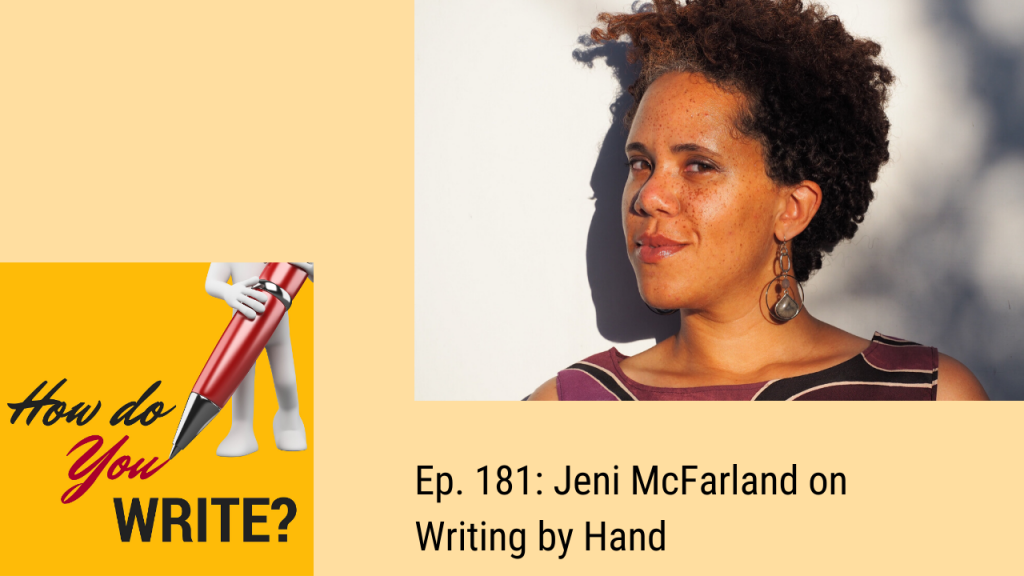
Ep. 181: Jeni McFarland on Writing by Hand

August 3, 2020

Jeni McFarland holds an MFA in Fiction from the University of Houston, where she was a fiction editor at Gulf Coast Magazine. She’s an alum of Tin House, a 2016 Kimbilio Fellow, and has had short fiction published in Crack the Spine, Forge, and Spry, which nominated her for the storySouth Million Writers Award. She was also a finalist for the 2015 Gertrude Stein Writers Award in Fiction from the Doctor T. J. Eckleburg Review. She has lived in Michigan and the San Francisco Bay Area with her husband and two cats. The House of Deep Water is her first book. 

How Do You Write Podcast: Explore the processes of working writers with bestselling author Rachael Herron. Want tips on how to write the book you long to finish? Here you’ll gain insight from other writers on how to get in the chair, tricks to stay in it, and inspiration to get your own words flowing. 

Transcript

Rachael Herron: [00:00:00] Welcome to “How do you Write?” I’m your host, Rachael Herron. On this podcast, I talk to authors about how they write, what their process is and how their lives fit together. I’ll keep each episode short so you can get back to writing.

[00:00:15] Well, hello writers! Welcome to episode #181 of “How do you Write?” I’m Rachael Herron and I am thrilled that you’re here with me today as I talked to Jeni McFarland, whose book just came out. It is called The House of Deep Water. I have just started it. It is beautiful and engrossing and engaging and kind of everything that I want to read right now. So I’m very excited that you will get to hear her talking about that process, talking about how she writes by hand, especially in these difficult times for concentration. So I know you will enjoy the interview. 

[00:00:56] In a very quick personal update; Everything is going great around here, which feels honestly very strange to say. I am doing just fine under the stay at home order. We are- it’s May 8th as I record this, in California here, we’re under stay at home orders until at least the 31st and I don’t mind. I really don’t mind. I miss a few things. I miss hugging my sisters and my best friends. I miss my recovery meetings and all that hugs that I get there. I miss swimming and I think that’s it. Otherwise it’s freaking fabulous. I love that everything has been canceled. I don’t have to travel even New Zealand got canceled, which wasn’t coming until August, but, I don’t mind. I, you know, New Zealand will be next year. They want me back next year. So that’ll be great. There’s this level of giddy relief at not having to go out and do things and driving exponentially less. I have started to listen to podcasts in the garden, so I’m actually catching up on podcasts, which was great cause I wasn’t listening to podcasts at all while I wasn’t driving for a while. Speaking of the garden I have been in there, we have a big backyard and it has well, I mean big by Oakland urban concepts, but, it goes down kind of gradual slope and then a steep slope down to the creek. This, this urban creek that’s behind her house and it’s actually, you have to go through two gates to get to it. So it’s kind of the secret creek that we never get to see. The secret bottom part of our yard is covered in ivy in very deep and dense and we never get down in there. I don’t even know if we can open the gate right now. That’ll be a project for another day. But the yard has been full, literally, no exaggeration of weeds up to shoulder height. And every year I get to this point and every year, every year for memory, I lose my mind, call somebody on Craigslist, have somebody come get rid of everything. And then we’ve got a, you know, semi decent yard to plant things in for the rest of the, you know, spring, summer and fall. This year I didn’t, I I’m trying to save money. All of that. And I’ve got, I don’t really have more time, but this week, this week I’ve had more time. Cause my book has been off my plate as it went to my editor. So I’ve spent like the last week out in the garden, most of the weeds are gone. I would say probably 75% of the weeds are gone. It looks great. And I’m building something that I’ve wanted for years and years and years, I’m building a- it’s called a cutting garden. It’s a flower garden that will just be full of riotous flowers in any which way I, I broadcast so the seeds, and it’s called a cutting garden because it’s for cutting it’s for cutting the flowers and filling your house with flowers that you grew.

I don’t know if it’s going to work, but I am getting a cubic yard of soil and compost dumped in my driveway at any moment, which then I will have to wheelbarrow back to the place that I kind of built. It’s going to be probably, it’s going to be slightly recently, like six inches of deep dirt above our ground. And I’m going to do that, I’m putting in automatic watering system with soaker hoses, and I’m also planting vegetables and all the things I normally do. And then, you know, sometimes fail to follow through with, but I’m really having fun with that and with moving my body and I had forgotten what it feels like to move my body. I’ve been working on this book for months and it hasn’t been great weather until recently, and it’s just been so beautiful to be outside and aching and, you know, pulling muscles. And, I’ve got cuts all over my body from walking around the, we have two cit- we have three citrus trees, all of which have thorns and, and you know, pruning those, oh it’s just been so good and yummy and wonderful. So I’ve been having a great time. It’s also exercise, which boosts my mood, who knew, never heard that before. So that’s been great. 

[00:05:17] I haven’t been doing any writing except I wrote a Patreon essay last week about How to Pack Lightly, which hopefully someday we’ll get to do again. I am borderline obsessed right now with eventually taking a trip with no luggage, just the purse and like extra tee shirt and a couple of pair of Joanie’s and go. Wash your clothes every night, when you go to bed. When I can’t sleep, I start thinking about that. I don’t know. I’m, I’m aware to, who’s obsessed with that. I should get my revision letter for Hush Little Baby on Monday from my editor. So I have the weekend to continue to do no writing. I haven’t kind of messing with some essays, but very lightly. And then on Monday, hopefully I’ll get my revision letter, my brain will explode with the trauma of it and what she says I need to fix, by now it’s been out of my hands for a week and a half, two weeks. And by now I’m convinced there’s nothing of worth in it at all. So if she says she likes anything, bonus, and I can revise anything into anything else, so that’ll be fun. But right now I’m enjoying not having that on my plate. 

[00:06:22] What I do have on my plate is that the 90 Days classes, the new three-month batch of classes started this week. And it’s amazing and wonderful and Tuesdays, which is when the classes are. I am just so happy. And somebody in a couple of people in one of the classes said, I love coming to this because I forget everything else. I forget the world. And I am immersed in talking about writing and Tuesdays feel like that to me, I just have this blast of energy, you know, giving and taking inside these classes. And it’s really beautiful. And I’ve mentioned it before, but my super power is gathering amazing people who lift each other up. I don’t know why it always happens to me, but honestly, I was talking about it with my wife one night at dinner and I was like, gosh, I shouldn’t say this out loud. I’ll get a terrible student who just wants to bring the rest of the class down and be insulting and demeaning. And then I thought, wow, no, this is not for Stanford. This is not for Berkeley. This is for me. This is what I teach. I would cheerfully refund that person to get them out of my class. Boom gone. I don’t have to worry about that, cause that never happens. And again, with this group of people, it is amazing, but it’s just been a very positive, very exciting week of real balance, I guess. Cause I haven’t been writing that much. Oh boy. We’ll get back into writing next week. 

[00:07:49] So in any case, I hope that you are finding some joy, finding some way to move your body, finding some way to love your writing. And I hope that you come tell me about it. And right now let’s get into the interview with Jeni McFarland. I know you’re going to enjoy it and we will talk soon my friends. 

[00:08:08] Hey, you’re a writer. Did you know that I send out a free weekly email of writing encouragement? Go sign up for it at www.rachaelherron.com/write  and you’ll also get my Stop Stalling and Write PDF with helpful tips you can use today to get some of your own writing done. Okay, now onto the interview.

Rachael Herron: [00:08:30] Well, I could not be more pleased today to welcome to the show, Jeni McFarland. Hi Jeni!

Jeni McFarland: [00:08:30] Hi, it’s great to be here. 

Rachael Herron: [00:08:32] I’m so happy to have you. Your first book when this airs next week, we’ll be out in the world. I know. So excited to talk to you about this. Okay. Let me give you a little bit of an introduction. First, Jeni McFarland holds an MFA in Fiction from the University of Houston, where she was a fiction editor at Gulf Coast Magazine. She’s an alum of Tin House, a 2016 Kimbilio Fellow, and she has had short fiction published in Crack the Spine, Forge and Spry, which nominated her for the story South Million Writers Award. She was also a finalist for the 2015 Gertrude Stein Writers Award in Fiction from the Doctor T. J.  Eckleburg Review. She has lived in Michigan and the San Francisco Bay area with her husband and two cats. The House of Deep Water, which will be out by the time y’all hear this is her first book and it just looks gorgeous. It’s already in my preorder. I, were trying to get me a copy before we chatted, but because of COVID, couldn’t quite get me one. So yeah. You know, things just aren’t being mailed as much, but- So where are you living now? 

Jeni McFarland: [00:09:42] I moved back to Michigan in October. So and then we bought a house in January just in time to go into lockdown. We were in a tiny apartment before with like boxes, stacked everywhere. So I’m so glad we’re like spread out.

Rachael Herron: [00:09:59] That’s wonderful. And your book is set in Michigan, too. Isn’t it? 

Jeni McFarland: [00:10:03] Yes. 

Rachael Herron: [00:10:04] Yes. I lived in Oakland so I don’t know where you were in the Bay area, but that’s where I’ve been for a lot of years. So-

Jeni McFarland: [00:10:10] Oh okay.

Rachael Herron: [00:10:11] Yeah. So let’s talk to you about writing. Congratulations, first of all on-

Jeni McFarland: [00:10:17] Thank you.

Rachael Herron: [00:10:18] -this year first book, how are you, how are you feeling honestly? I’d love to hear that from new writers, new- new books out in the world writers.

Jeni McFarland: [00:10:26] So honestly like today, I’m feeling great and I’m excited, but I’ve been terribly depressed lately and so I haven’t really like, people are like, are you excited? And I’m like, yeah, but I haven’t really been feeling it. Especially since my book tour was canceled. But yeah, no, I’m feeling good today. I’m excited. 

Rachael Herron: [00:10:47] Good. It’s a very, very strange time to be doing anything in the world, including launching a book. 

Jeni McFarland: [00:10:52] Yes

Rachael Herron: [00:10:53] But some of my friends yesterday, we were on you know, typical zoom writer meeting chatting about the state of the world. And we were all like, this is probably a good time for debut authors. There are people who are really looking for amusement and entertainment and books right now. I know I am so.

Jeni McFarland: [00:11:10] Yeah, that’s true. 

Rachael Herron: [00:11:11] Everything crossed. Well, let’s talk about your writing process since this is a show about that. Can you tell us about your process though? The when and the where and the how, and I’m taking, keeping in consideration. Of course, you’ve just moved into a brand new house, et cetera. 

Jeni McFarland: [00:11:29] Yeah. So I’m still kind of getting my office in line it’s I don’t know. I feel like I need to be surrounded by color and like pretty things when I’m writing and I haven’t had a chance to paint in here or hang drapes or anything like that yet. So it’s like, I, I usually paint in my living room. I’m sorry, not paint. I usually write in my living room these days but hopefully I will, I will get my space in order one of these days. 

Rachael Herron: [00:12:01] Well, it looks pretty with the lamp and the books behind you. So what is that I hear in the background? Is it a bird outside or a tiny kitten?

Jeni McFarland: [00:12:09] Oh yeah. I have, I think it’s a Blue Jay that they’re kind of loud. Yeah

Rachael Herron: [00:12:13] I love it. 

Jeni McFarland: [00:12:14] Currently that’s outside. 

Rachael Herron: [00:12:16] I’m going to put a bird feeder up inside of my, in front of my office. I pretty soon I think I want to just be able to watch them. So are you a morning writer afternoon, evening? 

Jeni McFarland: [00:12:23] Afternoon or evening. Oftentimes like lately it’s been at like 11 o’clock midnight. I am not a morning person. I try to sleep through as much of the morning as possible. So yeah, and then when I do get off, I don’t get a lot done before noon.

Rachael Herron: [00:12:42] That is, that is less of a common answer and I always like hearing it. So do you write into the wee hours when nobody else is awake or? 

Jeni McFarland: [00:12:49] Yes. Yeah. Sometimes when I’m, when I’m having a good writing day, I will write from like 11 until 2 and then kind of wandered to bed. 

Rachael Herron: [00:12:58] That sounds so fun.

Jeni McFarland: [00:13:00] I, yeah

Rachael Herron: [00:13:03] I like go to bed at 9, you know, it’s, it’s, it’s such a different thing. And I just think that people who write into the wee small hours are so romantic somehow, like the other day, two days ago, I got up at 3 and I just couldn’t sleep. And then I started writing and one of my best girlfriends that I crossed paths cause she, she usually stays up till 2 or 3 to write. So we kind of saw each other on Twitter as we were seeing shifts in the night. 

Jeni McFarland: [00:13:26] I will say when I was in high school, I used to write in secret, you know, in the middle of the night, cause I was a horrible insomniac and I didn’t want my mom to know. And so I would write by candlelight in the middle of the night, talking about romantic. 

Rachael Herron: [00:13:40] See that is the most romantic vision and it, and I actually remember being a kid and I want to say, some famous heroin in a book, maybe it was Harry at the spy or something would right underneath the covers with a flashlight. And I would take like notebooks underneath the covers with a flashlight. And then I would just feel as stupid as I do some days, like right now, when I write it like this, this is terrible. And then I would go to sleep. But yeah, I love that vision. So what is your biggest challenge when it comes to writing? 

Jeni McFarland: [00:14:08] I’m making myself sit still for, you know, a good chunk of time or making myself stay focused. I haven’t had a lot of focus these days. But yeah. I started in writing this book, I started writing by hand just because otherwise I would, I would, you know, pause, you know, and think for a while and then wander away to Twitter or whatever, if I’m on my computer. But yeah, writing by hand is a little, it’s a little bit easier to stay focused, a little better. 

Rachael Herron: [00:14:38] What is it like when you, because I’ve never written anything long- long hand, what is it like when you bring it in? Do you end up doing revisions on the way into the computer or? 

Jeni McFarland: [00:14:50] Yeah, oftentimes I do I’m so I don’t know. I give myself permission to just write whatever and it can be as crummy or worded as poorly as I want when I’m writing by hand and then I’ll fix it, you know, the first time that I type it up or add, or yeah, 

Rachael Herron: [00:15:05] Was most of the book written that way? 

Jeni McFarland: [00:15:07] I would say… so I- when I started doing that, I had like a, you know, not a full draft, but fairly full first draft. So like the second draft, and subsequent drafts were written that way. 

Rachael Herron: [00:15:23] Wow. So you actually leave the document and go out of it to write another, write the next draft. 

Jeni McFarland: [00:15:29] Yes. Yes, cause I don’t know, like I find that I’m kind of anxious that like, what if I edit something that I want later? So if I just use like a totally new draft, then I, I, I never go back to the old ones, but I just feel more comfortable because they’re there. 

Rachael Herron: [00:15:46] I absolutely agree with that. I actually went back into a draft yesterday to pull out one paragraph, which I think I’ve never done before. But I did have it safely saved as like yesterday’s word document or something. Yeah. Are you a plotter or a pantser when it comes to writing? 

Jeni McFarland: [00:16:00] I’m more of a pantser. I- I’m trying, starting my second novel right now. And I’m trying to find, like I started with an outline and an idea of like where the plot was going to go and it’s not working for me. I think, I dunno, I think I- I’m way more interested in the characters than the plot and like the plot just kind of comments from the characters and like what they would do in a situation so I, I definitely start with character sketches, but not with that plot so much. 

Rachael Herron: [00:16:30] I love that. What is your biggest joy when it comes to writing? 

Jeni McFarland: [00:16:35] Ooh, I love to take a character who might resemble somebody I know, who I just don’t understand and like, just sit down and spend some time with them and try to figure out, figure them out, like figure out what makes them tick or like why they do the things they do.

Rachael Herron: [00:16:54] How much do they end up changing on the page? And I only ask that because sometimes I’ll bar borrow someone I know, and then I write about them for so long that it turns into a completely different person. And I almost forget that I based them on someone. Do you do that or do they kind of stay true? 

Jeni McFarland: [00:17:10] No, they, they tend to take on their own life, which is good cause I feel like then I’m less likely to have people come back later and be like, why did you write that about me? Yeah. 

Rachael Herron: [00:17:20] Yeah, yeah. Which is going to happen anyway. And it’s usually about the wrong people. Yeah. Can you share a craft tip of any sort with us? 

Jeni McFarland: [00:17:29] Oh, a craft tip. That’s very open. I don’t even know where to start 

Rachael Herron: [00:17:35] Very open-ended, oh, I hope that the publicist would have sent these to you, but, but it is okay. Let’s I can help you drill it down. What help- what is it, what is something you do on a, on a regular basis with maybe character that helps you build them? Since your kind of like a character driven person. 

Jeni McFarland: [00:17:53] Yeah. I dunno, I do like to start out just, I- I’ve tried the thing where you, where you write, like you write down what their birthday is and what their favorite color is and their favorite food. And I don’t find that as helpful as like starting with just describing them physically. And then from there, think about, always think about like what their insecurities would be based on the way they look, because we all have those and then,

Rachael Herron: [00:18:20] Oh what a great idea. 

Jeni McFarland: [00:18:22] The way that they try to kind of navigate the world with those, with, you know, whatever their issues are.

Rachael Herron: [00:18:30] That it sounds so simple. And I have never thought of doing that. Like I know how I navigate through the world with my big belly, like, and I know how I stand in order to try to put that away. And I never thought about, you know, giving characters, that kind of thing that they’re either showing or hiding. That’s awesome. 

Jeni McFarland: [00:18:46] Yeah

Rachael Herron: [00:18:47] That’s really beautiful. I’m sorry to put you on the spot with a question you didn’t see coming there. I apologize. This might, this might also take you back, but what thing in your life affect your writing in a surprising way? 

Jeni McFarland: [00:19:01] Oh, I would say my husband’s going to hate this answer, but I would say him and his moods. So when he’s in a bad mood, I’m, I’m getting better at like kind of shutting his emotions out. But you know, after 11 years of marriage, but I’m still not great at it. So oftentimes like just other and it’s not just him. It’s, it’s other people in general, like other people’s moods when they’re around me, I tend to take on their feelings a little bit.

Rachael Herron: [00:19:33] I feel I have this theory that writers are severe empaths as a general role. So I think that a lot of us struggle with that. Luckily, luckily, my wife is very, very like mood normalized? 

Jeni McFarland: [00:19:50] Oh nice,

Rachael Herron: [00:19:51] Yeah. It’s, it’s nice. But if she weren’t, I can imagine that that would wreak havoc, especially, especially in the times of COVID-19 when we are all in the houses with our significant others, 

Jeni McFarland: [00:20:00] You know what though, he kinda loves working from home. Like, I think he’s happier without a commute. So he’s been in a fairly good mood lately. 

Rachael Herron: [00:20:09] Everyone’s happy without a commute. Aren’t they? 

Jeni McFarland: [00:20:11] Yeah

Rachael Herron: [00:20:12] Like it’s the best. Good answer. What is the best book that you read recently? 

Jeni McFarland: [00:20:19] I recently finished Tayari Jones’ An American Marriage and it was-

Rachael Herron: [00:20:24] It look so good. Is it?

Jeni McFarland: [00:20:26] Yeah.

Rachael Herron: [00:20:27] What did you love about it?

Jeni McFarland: [00:20:33] So I guess I might be a misanthrope in this way, but I love watching people’s relationships deteriorate. 

Rachael Herron: [00:20:43] Yes

Jeni McFarland: [00:20:44] So just seeing like the, so you know, a little teaser for people, the book is about a man who’s a black man who’s wrongfully incarcerated. And just watching his marriage fall apart was heartbreaking, but also just, I couldn’t stop reading it. 

Rachael Herron: [00:21:02] I run toward those kinds of things and the wifi spoke up. She’s just like, I don’t understand why you’re such a terrible person and I’m like, I’m not, I just love the more uncomfortable and difficult it is, the more I lean in. 

Jeni McFarland: [00:21:17] Yeah. Same here. I feel like if it’s, if it’s a happy book I’m not terribly interested. Like and I taught when I was in grad school and my students were, I told them at the beginning of the semester, I was like, we’re not going to read any happy books, just so you know. And halfway through the semester, they were like, are we ever going to read a happy book? And I was like, were you listening the first day? It’s not going to happen.

Rachael Herron: [00:21:38] But I actually gain- gain happiness by reading those. And by watching difficult television. I, that I gained like

Jeni McFarland: [00:21:45] Yeah, me too. 

Rachael Herron: [00:21:46] So I like that. Okay, so now I would like you to tell us about your book with a little bit of what it’s about, where it can be found all of that. 

Jeni McFarland: [00:21:57] Sure. So my book is briefly it’s about a woman, she’s half black, half white, she’s about 40, she moves back to the small Michigan farm village where she grew up amid financial troubles and she gets there and she moves back in with her father. She gets there and she finds that he has a live in girlfriend, who is a girl that she babysat in high school. And this is right as their neighbor has been arrested for just horrific crimes. And she was one of the victims as a child. So it’s a lot about homecoming and reconciling your past and yeah.

Rachael Herron: [00:22:34] And does it mom come back to, isn’t there? 

Jeni McFarland: [00:22:39] The girlfriend, the living girlfriend’s mom.

Rachael Herron: [00:22:41] The living girlfriend’s mom. Okay. 

Jeni McFarland: [00:22:43] So, and then her mom moves back. Yeah. So it’s these three women coming back to town.

Rachael Herron: [00:22:47] Yeah. Sounds like it is entirely my jam. I cannot wait to read it. It is called The House of Deep Water and that’ll be out by the time you all hear this, it’ll be on all the platforms and all the bookstores. And I would like to encourage people to buy it and go get a curbside pickup from your favorite bookstore. I’m in a point where I’m not buying anything from Amazon right now, nothing for my Kindle, getting the- cause we have to support our independent bookstores right now, as much as possible.

Jeni McFarland: [00:23:13] Yeah

Rachael Herron: [00:23:14] So people call your independent bookstore. They will love you. They will kiss you from six feet away and leave your package on the curb. So The House of Deep Water. Thank you so much, Jeni. This was fantastic. I wish, I hope all the best for you and that the book just flies from the virtual shelves. 

Jeni McFarland: [00:23:32] That would be amazing. Thank you. 

Rachael Herron: [00:23:34] All right. Take care. Thank you so much. 

Jeni McFarland: [00:23:36] Yeah.

Rachael Herron: [00:23:37] Bye. 

Thanks so much for joining me on this episode of “How do you Write?” You can reach me on Twitter, twitter.com/RachaelHerron, or at my website, www.rachaelherron.com, you can also support me on Patreon and get essays on living your creative life for as little as a buck an essay at www.patreon.com/rachael spelled R, A, C, H, A, E, L and do sign up for my free weekly newsletter of encouragement to writers rachaelherron.com/write/

Now, go to your desk and create your own process and get to writing my friends.
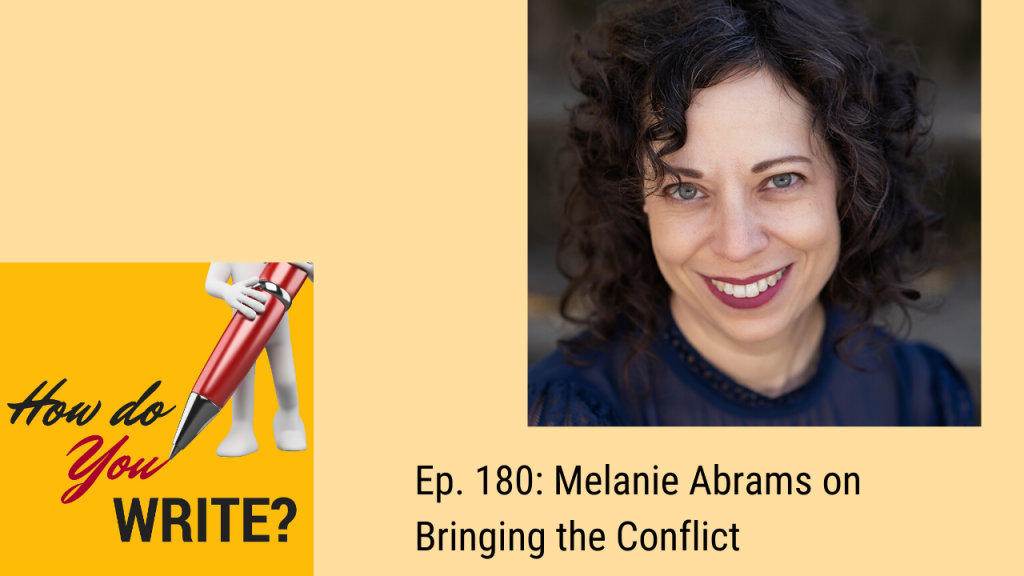
Posted by Rachael Leave a Comment

Ep. 180: Melanie Abrams on Bringing the Conflict

May 26, 2020

Melanie Abrams is the author of the novels Playing and Meadowlark. She is an editor and photographer and currently teaches writing at the University of California, Berkeley. She lives in Oakland, California, with her husband, writer Vikram Chandra, and their children.

How Do You Write Podcast: Explore the processes of working writers with bestselling author Rachael Herron. Want tips on how to write the book you long to finish? Here you’ll gain insight from other writers on how to get in the chair, tricks to stay in it, and inspiration to get your own words flowing. 

Transcript

Rachael Herron: [00:00:00] Welcome to “How do you Write?” I’m your host, Rachael Herron. On this podcast, I talk to authors about how they write, what their process is, and how their lives fit together. I’ll keep each episode short so you can get back to writing.

Well, Hello writers! Welcome to episode #180 of “How do you Write?” I’m Rachael Herron.

[00:00:21] Thrilled that you’re here with me today, as I talked to Melanie Abrams on her book that came out today called Meadowlark. She’s a stunning writer and we’re going to be talking about bringing the conflict and you are really going to enjoy her. I know that. My apologies for getting this out a few hours late, better late than never, has some parts I just skipped, but I’m really trying to be a little bit more regular. But this week was thrown off a little bit by a massive migraine that knocked me out for a couple of days. And then yesterday, I don’t know if you could hear that, but my wife is howling of laughter in the kitchen. Don’t know why, what. Maybe she’ll come tell us. 

[00:01:03] So that threw some things off track, like getting my new 90 Day courses started, which is what I needed to do this morning, opening them. 90 Days to Done, 90 Day Revision, are open now and sadly the last two classes have closed. And I just have to say that teaching 90 Day Revision and 90 Days to Done, this last 3 months, for these last 90 days. Oh my God. The whole world changed. In 90 days, everything turned upside down, and I have to tell you, the writers that were working in those classes, moved to meet these new challenges with such beauty and such grace and I could not have been prouder of the work that they did. And they finished whole books. They finished whole revisions, in a time when I think people need to give themselves a big break. You know, like don’t try to, you know, everybody’s saying, don’t try to read your novel right now, they actually did. They actually did and I’m so proud of them. So yeah, that was really exciting. And the new classes start today, and this podcast is going on today, and then maybe I might get a couple of days off. I don’t know. I haven’t managed to do it yet. It isn’t my goal to do so. I’ve got so many goals, so many things I want to do, so many new things I want to write. I just put out a Patreon essay yesterday about how to pack light because I’m finding that as a traveling wanderer, who should be in Barcelona right now, this very minute. I need to keep travel dreams alive as part of mental health for me. I need to be rejiggering my packing list and thinking about not just travel, but who I am when I travel, and seeing how I can bring that person into where I sit at this desk today. So that’s what that essay was about. And that was really fun to write.

[00:03:02] Speaking of Patreon, you got the essay if you are a patron of mine, and I thank you deeply from the bottom of my heart. Thanks to new patron, Dee Deploy. I don’t know if I’m saying that right, but Dee Deploy, thank you. Thank you so much. Everyone else who wants to read those kinds of essays, you could do it for $1 for one month, read all 39 essays and then unsubscribe. You could do it $1 for like 200,000 words worth of work in there. So, um, there’s some good stuff in there. You can always find that over at patreon.com/rachael. And now let’s just jump right into the interview with Melanie and I hope that wherever you are, whatever you are doing, you are getting a little bit of work done. Come find me anywhere where I live online and tell me about it. I really love hearing from you all. Okay. Happy writing!

[00:05:09] Hey, do you want to do more writing on Zoom with a group of people that you like? Well, you should join Rachael Says Write. We write together on Tuesday mornings from 5:00 to 7:00 AM Pacific standard time, 8:00 to 10:00 AM Eastern standard time. This one works for you Europeans, and on Thursdays from 4:00 to 6:00 PM Pacific standard time, 7:00 to 9:00 Eastern standard time, New Zealand and Australia. This one’s for you, and for just $39 a month, you can write with us in Zoom, it’s like 16 hours for a month. It’s like $2 an hour to sit in a Zoom room with really cool people and spy on them while they’re writing and let them spy on you while you’re writing. They’ll get to see your true writers face and there is nothing more intimate than that. Honestly, you guys, it’s such a good time. Go to rachaelherron.com/write  or rachaelherron.com/rachaelsayswrite to find out more about joining.

Rachael Herron: [00:05:04] Well, I could not be more pleased to welcome to the show today, Melanie Abrams. Hello, Melanie. How are you? 

Melanie Abrams: [00:05:09] Hello! Enduring. 

Rachael Herron: [00:05:11] You’re enduring your sheltered in place. 

Melanie Abrams: [00:05:04] Yes

Rachael Herron: [00:05:15] So I am very glad to talk to you. I’ve had a couple people say, are we still on? And I’m like, hell yes we are! And it’s the best time to do it. Let’s talk about something else. So a little bio for you, is Melanie Abrams is the author of the novels Playing and Meadowlark. She is an editor and photographer and currently teaches writing at the University of California, Berkeley. She lives in Oakland with her husband, Vikram Chandra and their children. He’s also a writer. But you are the writer I’m talking to today and I couldn’t be more pleased to talk to you. We know each other through NaNo channels. Which are some of the best channels always to know people from, we met through Grant Faulkner, who’s been on this show, and we recently did a NaNoLitMo with you, which is our local reading series. And if anybody’s listening, please check out NaNoLitMo on Facebook and come to our next event, which might be never! You may have, you may have had the last event we’re going to do 

Melanie Abrams: [00:06:11] Just say it isn’t so. 

Rachael Herron: [00:06:13] No, it isn’t so, it isn’t so. But it’s very nice to have you in your, to be talking to you in your writing digs, ‘cause you have a, you have a home to write in. Is that right? 

Melanie Abrams: [00:06:23] I do. Right now, I’m writing from an abandoned house. Now I have a friend who actually has two houses and they have sheltered in place at one, and so I’ve escaped to their other to do some writing. 

Rachael Herron: [00:06:35] Truly ideal,

Melanie Abrams: [00:06:37] Absolutely

Rachael Herron: [00:06:37] And everybody right now is a tiny bit jealous. So, that’s always fun. Tell us about your writing process. That’s what this show is really about, is about how you get the work done, and one way is to have a friend with an empty house, which totally get behind, but how do you get it done with all the other things that you’re doing, you know, mothering and teaching and all of that. 

Melanie Abrams: [00:06:57] Yeah, no, it’s a great question. I mean, obviously, how I get the work done now, it looks very differently than how I get the work done on a normal basis. But we’re going to go with quote unquote normal and that is like for me, I usually am super, super lucky and that I teach at UC Berkeley and that’s, you know, classes there are only two days a week. So I try and get all my teaching stuff done in those two days. So that means, you know, meeting with students in office hours, grading, prepping for class, et cetera. And so I keep those two days for teaching. And the other three days I reserve for writing, which is obviously easier said than done with children, and you know, everything else that we have to do. But I really do kind of reserve those mornings usually it’s, you know, it usually ends up being like after drop-off until lunchtime to write. So those three days a week. But I also, in the past, and this has evolved a little bit over the years, but have given myself a word count that I have to meet each day. It started as 500 words, which I talked to my students about this, and they’re always shocked that it’s so little it’s funny because actually my husband also does this, but he writes even less, it’s 400 words a day. So I always talk about how, you know, it’s a marathon, not a sprint. 

Rachael Herron: [00:08:23] Yeah

Melanie Abrams: [00:09:24] And so the best thing to do is to set low, a low bar for yourself. But I think what’s interesting is that I actually, with this last novel was able to raise that to a thousand words a day. And which I had never been able to do before. So I don’t think other than maybe magic, I’m not sure why, you know, that that changed, but a thousand words felt very doable and manageable without feeling, oppressive.

Rachael Herron: [00:08:51] I don’t know if you’ve ever had this, but no matter what my word limit and what my word goal is, ‘cause I also work with word goals, but about the time I’m 300 or 400 words away from it, it seems impossible. 

Melanie Abrams: [00:09:01] Yeah

Rachael Herron: [00:09:02] Whether that’s 1000 or 3000 or 500 like if it’s 500 at 100 I start to think I can’t do this. You’re never going to get there. 

Melanie Abrams: [00:09:10] I’ve definitely had that too. I think that ti- having a certain amount of time in which you have to do it, like it ends up being that a lot of the words end up being in the last or however long you have left. 

Rachael Herron: [00:09:23] Yes. Yes, totally. So you mentioned that’s your, that’s your ideal way to do it, but what I do kind of want to talk about now, I guess like how-

Melanie Abrams: [00:09:32] Yeah

Rachael Herron: [00:09:33] How has that, how is that changing and are you able to focus on writing?

Melanie Abrams: [00:09:36] Yeah. That’s a good question. I mean, you know, it’s interesting. I’ve started a new novel and it started before the pandemic, so how the writing is going to go on that novel after the pandemic. Well, I’m not sure, but what was, so what was interesting about starting that novel is that I started writing it in a way in which I have never written before. I mean, I am one of those writers super dedicated to just, you know, putting your butt in the chair every, you know, whatever days you determined between this hour and this hour and just doing the work, like absolutely not an inspiration kind of writer, but this latest book has kind of taken me by surprise, in wa- because I feel- I’ve had the urge to write at night, which I have never had in my life. 

Rachael Herron: [00:10:21] If I had that happen, 

Melanie Abrams: [00:10:22] Yeah

Rachael Herron: [00:10:23] I would think I was having a brain tumor. Like, 

Melanie Abrams: [00:10:25] Honestly, I am so with you, it has been so shocking. I’m so glad that you can, you have this experience as well

Rachael Herron: [00:10:33] Yeah

Melanie Abrams: [00:10:34] Because it’s just so bizarre. So yeah, so writing at night and writing in spurts, which is like what every, you know, writer or every, I don’t know what I’m looking for, is that every mother is told, “Oh, find the time to write whenever you can just write in these little pockets of time when the baby is sleeping or your kids are at school.” And I’ve always been like, “yeah, what the hell ever.” That’s like, you know, completely un-useful advice for me. But that’s kind of a little bit what’s happened with this last novel. So we’ll see how it goes. I mean, you know, this is very beginning times. 

Rachael Herron: [00:11:05] Super exciting. 

Melanie Abrams: [00:11:06] Yeah. So, but as for like, writing in the middle of the pandemic, I definitely am writing very little fiction now. I have this book coming out, so there’s a lot, you know, everyone wants you to be doing all kinds of essay writing, so, in order to publicize the book. So that’s kind of what I’m doing right now and that definitely feels like work. Like I am not a nonfiction writer, at all. So, this definitely feels it’s, there’s not much pleasure involved in this kind of writing, so I feel like I can do it during the day or when I have to, you know, when it’s a quote unquote assignment.

Rachael Herron: [00:11:40] Yeah. Because it’s a put your butt in the chair kind of assignment. 

Melanie Abrams: [00:11:43] Yeah, exactly. 

Rachael Herron: [00:11:44] I have a book due in three weeks to my editor, and I just have this really strange feeling, and I think this is the first time I, I’ve verbalized it, but like, this book has nothing to do with pandemic. And then, so why is it therefore existing? Like I have people hugging in it and I’m thinking, Oh, they hug, you know.

Melanie Abrams: [00:12:02] Boldly. Somebody else said that they were watching TV and every time somebody touched, they got close, right?

Rachael Herron: [00:12:08] I felt that last night.

Melanie Abrams: [00:12:10] Yeah. Yeah, 

Rachael Herron: [00:12:11] Totally. 

Melanie Abrams: [00:12:12] I mean I’ve thought about that too. Like, what is my next book going to look like? You know, how do you not write about the pandemic, after the pandemic. But someone had a really good point. We’ll see, we’ll see what happens. But, also, you know, not all books are about 911, 

Rachael Herron: [00:12:28] Right and this is how we felt then. Yeah. 

Melanie Abrams: [00:12:29] Yeah. Exactly.

Rachael Herron: [00:12:30] That’s a very, very good point that actually makes me feel strangely better, 

Melanie Abrams: [00:12:32] Right. 

Rachael Herron: [00:12:33] In a terrible way. 

Melanie Abrams: [00:12:34] Yeah, 

Rachael Herron: [00:12:36] Exactly. What is your biggest challenge when it comes to writing? 

Melanie Abrams: [00:12:41] Definitely time. And childcare. I mean, I think you’re probably would hear this from any mother slash writer, you know, I applied, there’s, there’s some great grants out there like sustainable arts foundation, which is just for parents or even like yado or mucked out. The only reason I’m applying to any of those, ‘cause it buys you time. So that is exactly, I mean, that’s my biggest challenge is like the time piece of it. 

Rachael Herron: [00:13:07] Yeah. Yeah. What is your biggest joy when it comes to writing?

Melanie Abrams: [00:13:11] You know, it’s that kind of, you know, the, my, one of my favorite quotes is a Bob Haas quote, which is he says that, Writing is hell, not writing is hell. The only enjoyable part is having just written. 

Rachael Herron: [00:13:23] Yes

Melanie Abrams: [00:13:24] Yeah, right? So I’m kind of a big fan of that quote, but that’s so pessimistic. So I will say the optimistic part of that is that those few and far between moments where you’re almost in this kind of dis-associative state where you’re like part writer, part your character in a way, or inside your book slash outside of your book. And of course they only last for a limited period of time, but that’s that’s a pretty good one. 

Rachael Herron: [00:13:49] I wrote a bunch of words this morning before 7 because I had to, and I had that feeling and then it makes me think of that other Zadie Smith quote where she says, “The best time of writing is right after you sent it to your editor, and that only lasts for four and a half hours.”

Melanie Abrams: [00:14:04] Yeah, I agree. Every time someone sells a book, I’m like, enjoy it. This is the best time after you’ve sold it before you have to do any editing, that’s it. 

Rachael Herron: [00:14:12] Or right after you send it for that four and a half hour. 

Melanie Abrams: [00:14:14] Right, right.

Rachael Herron: [00:14:15] Exactly. Can you share a craft tip of any sort with us? 

Melanie Abrams: [00:14:20] Yeah. So I mean, my students, I think by now if they feel like they’re being hit over the head with me saying this all the time, but it is kind of my go to craft advice, which is that make just don’t neglect conflict. I usually use this Three D analogy, which is actually a Janet Borough analogy, but it’s desire plus danger equals drama. Like make sure your character wants something, put things in the way of them getting that thing and then if he can do that, then you’ve created drama, i.e.: Conflict. And just following that through your novel or short story. 

Rachael Herron: [00:14:53] I love that phrasing. Can you tell us the Three D’s again? 

Melanie Abrams: [00:14:56] Yes, so it’s Three D’s, these are Desire, plus Danger equals Drama. 

Rachael Herron: [00:15:01] That’s lovely. And yeah, that is something that everyone needs to remember. We don’t want to hurt our characters that we love so much. We don’t want to give them conflict. So, yeah. Perfect. Thank you. I think that your students are lucky that you hit them over the head with that. What thing in your life affects your writing in a surprising way? 

Melanie Abrams: [00:15:20] I think, I think music this is particularly accurate for my, the novel I’m working on now, but I have found myself as I’ve gotten older, more and more, not necessarily influenced by music, but kind of existing in a space with music and the way I exist with books. And having the music kind of influenced the writing, which I, which is kind of a new thing to me, but it’s been pretty powerful. 

Rachael Herron: [00:15:48] So can you explain that a little bit more? Are you, do you choose music for your books and then live in it, or do they come to you around the book or how does that work?

Melanie Abrams: [00:15:58] Such a good question. It’s, I think it’s kind of fluid. I definitely have found myself lists like making a playlist and listening to that playlist over and over and over again, because that playlist is informing the book in some way. And it’s hard to, like again, using this magical word, but like, it does seem a little bit like magic. Like I’m not sure exactly how one influences the other, but I’m definitely drawn to using music as a way into the book. Yeah. So feel free to ask clarifying questions – 

Rachael Herron: [00:16:31] How do you, how do you find the music?

Melanie Abrams: [00:16:34] Yeah. Some of it you know, some of it is people recommend this or that that’s happened a couple of times. Some of it is all I, Oh well here’s a really good one. So there’s this do you know about radio paradise? Do you know that station?

Rachael Herron: [00:17:46] No, I do not.

Melanie Abrams: [00:16:47] So, radio paradise is a streaming service that is a brand by this like older couple outside, inside Paradise, California where there all the fires were, 

Rachael Herron: [00:16:57] Yeah

Melanie Abrams: [00:16:58] And its 24-hour streaming and they curate these playlists, which are, I believe basically made for me and, but really it’s like a very, it’s not that you have to be gen X to appreciate and love it because there-

Rachael Herron: [00:17:09] Which I am, so…

Melanie Abrams: [00:17:10] Right, but it definitely has a gen X slant to it. So it’s like, you know, there’s some stuff that’s familiar, some stuff that’s less familiar, and that has been super, super fantastic for exposing me to either new music or music that I knew that I forgot or, you know, just finding things that weren’t necessarily in my, you know, head well before I started actively pursuing new music. 

Rachael Herron: [00:17:36] Yeah.

Melanie Abrams: [00:18:37] So I highly recommend 

Rachael Herron: [00:17:38] I have, I’ve been experimenting with music a lot more. For some reason, I had a couple of years where I wasn’t ready to music at all. And lately, I have been more pulled back to it. And I have found this way of, creating Spotify lists. 

Melanie Abrams: [00:17:50] Yeah

 Rachael Herron: [00:17:51] I am a Spotify person, so I’ll put on one of those like deep focus, John Hopkins, Moby kind of electronica stations. And then as soon as the music bothers me, I go back and replay the mu- the song that was right before it. Because I was obviously deep. And it didn’t bother me. And then if I love it, I move it over to a playlist for the book. But this is –

Melanie Abrams: [00:18:11] I love that

Rachael Herron: [00:18:12] Only occurred to me in the last two weeks. Like we’ve all been doing a lot of distraction focus work this year, 

Melanie Abrams: [00:18:18] Yeah

 Rachael Herron: [00:18:19] recently. So, but I love, I’m going to try radio paradise. That sounds fantastic. 

Melanie Abrams: [00:18:23] Yeah. And the other two things I would say is that, one is that if you like this kind of music book connection, I, if do you know about large hearted boy I website? 

Rachael Herron: [00:18:32] Yes, of course. Yeah. Yeah.

Melanie Abrams: [00:18:34] So they, you know, I just did for the new book a playlist for them, based on the characters, which is super fun.

Rachael Herron: [00:18:39] I haven’t been in that website on in so long. I literally forgot that it existed. That’s awesome. 

Melanie Abrams: [00:18:44] Yeah, I’d recommend that.

Rachael Herron: [00:18:47] Cool! Okay, and you’re gonna say the second thing too. 

Melanie Abrams: [00:18:49] Oh, and the only, the second thing is, is that it’s interesting that you said you’re writing to music, because I find that I have, I get inspired by this music, but very, pretty quickly I have to turn it off. Like within, you know, I don’t know, 20 minutes of writing, like I have a hard time writing to music. 

Rachael Herron: [00:19:04] For me, it has to, for the actual writing to music, it has to be without words. If there are words that I can understand, I can’t. Right now I’ve got like a, like a Gregorian chant. Like I was writing in the eighties right when I was, you know, 15, I’d put on Gregorian chants and write to. So maybe I’m going back to that,

Melanie Abrams: [00:19:20] That’s awesome.

Rachael Herron: [00:19:21] Yeah, but it’s all very strange. What is the best book that you read recently and why did you love it? 

Melanie Abrams: [00:19:26] Yeah. You know, I’m, I was thinking about this one, and I think I’m going to have to go with Three Women. Have you read that? 

Rachael Herron: [00:19:32] No

Melanie Abrams: [00:19:33] So it’s this nonfiction book that kind of blew me away. It’s about women’s desire and sexuality, and it’s traces the stories of these Three Women and it’s fascinating because it, I think it does an incredible job of really, nailing women’s desire and how they feel about sex and how they feel about their own sexuality and all those kinds of things. But as important to me was the way in which this, the author, it’s Lisa Taddeo, I think her name is? Is able to, write nonfiction in a way that feels as a. as compelling as fiction, and b. as voice-driven as fiction. And I think of that voice-driven piece of it was what I was just so amazingly impressed with.

Rachael Herron: [00:20:20] That sounds like everything that I want to read. 

Melanie Abrams: [00:20:22] Like, oh God, it’s so good.

Rachael Herron: [00:20:23] For me that my fa- my favorite kind of thing is to read nonfiction. Not always memoir, but something that is really, really voice-driven. Have you read Savage Appetite?

Melanie Abrams: [00:20:32] No, but I’m putting it on my list. 

Rachael Herron: [00:20:34] It is if you have any interest in true crime, 

Melanie Abrams: [00:20:36] Yes.

Rachael Herron: [00:20:37] Or even if you’re just mildly titillated by it, you’re going to love this. It’s nonfiction and it’s got the strongest voice ever. And she, she takes apart four women who have been in the true crime area and takes them apart, and also talks about her own fascination with true crime and women’s fa- fascination with true crime. So, oh, thank you for the excellent book swap, because I’m absolutely going to read that one next.

Melanie Abrams: [00:21:00] Awesome. 

Rachael Herron: [00:21:01] Speaking of wonderful books to read, would you tell us please about your latest book Meadowlark? 

Melanie Abrams: [00:21:06] Sure. So, Meadowlark is the, the backstory to the novel is that it’s there’s these two teenagers who grew up on a strict Eastern leaning spiritual compound. And they run away when they’re 15, and they lose touch. And they grow up in the, the present of the novel takes place, when they’re grown-ups. Simron, who is the, the girl who ran away is a photo journalist, and Arjun, who is the boy who ran away now has his own, is the head of his own kind of commune that believes in kind of allowing children to just be and discover their quote unquote special gifts. So it’s very opposite to what they grew up with. And there’s tensions between that commune, which is called Meadowlark and the police. And so he asks Simron, they reconnecting as Simron to come and photograph the commune. So to get their story out there, to kind of show that, you know, the normalcy of what they’re doing, which isn’t actually very normal at all. So she comes with her young daughter and ends up getting, caught in there as tensions between the police and the commune, heightened. So a little bit of a page journey thriller, a little bit of the literary kind of character driven thing. You know, we are all looking for.

Rachael Herron: [00:22:29] That’s a little prison of cult which we all, 

Melanie Abrams: [00:22:32] Right

Rachael Herron: [00:22:33] Oh, not we all but many of us, I don’t know why we’re so drawn to this. But I definitely am. I’ll read anything with that, and I haven’t read your book yet, but it’s at the top of my TPR pile. And I did read your book playing, which is just gorgeous and you’re such a beautiful writer. So I would really encourage people to go out and grab Meadowlark. You will not, not regret it. So, thank you so much. Oh, where can we find you online? Where, where are you? Where do you live? 

Melanie Abrams: [00:22:59] Yeah, Facebook, melanieabramswriter and Instagram, melanieabramswriter 

Rachael Herron: [00:23:04] Perfect. 

Melanie Abrams: [00:23:05] And obviously my website, melanieabrams.com 

Rachael Herron: [00:23:09] Yay! Thank you so much for being with me on this very weird, weird time. It’s incredibly nice to connect. 

Melanie Abrams: [00:23:16] Yes, absolutely. Thank you. 

Rachael Herron: [00:23:18] You’re welcome. And we will talk soon. Thanks so much for everything. 

Melanie Abrams: [00:23:21] Alright, bye. 

Thanks so much for joining me on this episode of “How do you Write?” You can reach me on Twitter, twitter.com/RachaelHerron, or at my website, www.rachaelherron.com, you can also support me on Patreon and get essays on living your creative life for as little as a buck an essay at www.patreon.com/rachael spelled R, A, C, H, A, E, L and do sign up for my free weekly newsletter of encouragement to writers rachaelherron.com/write/

Now, go to your desk and create your own process and get to writing my friends.

Posted by Rachael Leave a Comment

Ep. 179: Should You Get an MFA?

May 26, 2020

Bestselling author (and teacher) Rachael Herron talks about why you should (or shouldn’t) get an MFA in writing.

Transcript

Rachael Herron: Welcome to “How do you Write?” I’m your host, Rachael Herron, and this is a bonus episode brought to you directly by my $5 Patreons. If you’d like me to be your mini coach for less than a large mocha Frappuccino, you can join too at www.patreon.com/rachael

Well, Hello writers! Welcome to episode #179! It’s a bonus mini episode with me, Rachael Herron. 

[00:00:22] And today I’m going to be talking about a question I get a lot and I’ve actually gotten it for some reason, three times in the last week. So I don’t know, maybe application season is upon us. But today I’m going to be talking about Should You Get your MFA? Let’s talk about it. What is an MFA? an MFA is a Master of Fine Arts, and you can get them in all of the fine arts, basically bookbinding and dancing and I don’t know if it, yeah, book finding would be a fine art, and fiction and poetry and creative nonfiction and whatever the heck else you want in Fine Arts. You can get a master’s degree in it, which is awesome. I have a master’s degree. I like having a master’s degree because I am snotty. And I like to say that I have one. I like to be able to have that. I always wanted a doctorate and I’ve even looked into getting a doctorate. I’m doing the next step and every time I do, I back away and say, no, I actually don’t want that. And there’s no reason for me to have one except for cache. That’s the only reason. And for me, that’s not a big enough reason.

[00:01:30] So let’s break it down. Should you get a Master of Fine Arts in Writing? I say, yes, you should get one if you want one. If you, and I’m not, I’m not just saying that flippantly. If you want one, if it will make you feel better about yourself as a human being, because of the cache or because you know, you always wanted a master’s degree in something, you want to prove your mastery over something with little letters that can go after your name. That’s a great reason. That is the- get one. Go ahead. But I would also add to this and get one if you want one, and you can afford it without going into debt. I think that going into debt for a Master of Fine Arts is so stupid. And I did it, so I get to say it, it was so dumb. I spent, almost, I spent like 17 years, paying that off I think. It was about maybe 16 years paying that off and some of you have heard me talk about this, but I did forbearance a million times. I was living in the Bay area as a dispatcher, not much money, no idea how many worked. So I was in a lot of debt in a lot of ways. So I kept pushing off, paying back that, that I had borrowed $40,000. But then, you know, I got the job and I start paying it back. I was paying $350 a month. I paid $26,000 of it back. So let’s do the math. I borrowed 40,000 I paid them 26,000, when I logged in to see how much I owed, I owed 50,000. That is how much the interest had gotten me. It’s just madness that after paying $26,000 of a $40,000 loan, I owed 50,000. I was so furious. There’s a blog post about it. You can search it on my site. But then my wife and I spent the next year throwing every single dollar we had at it and we paid it off in a year because I was so furious and we ate beans and I was working two jobs and we had the privilege to be able to do that. I have the privilege to be able to work a good full time 911 job, and I was making money writing, so pay that off. But I’m still, I’m still angry about that. 

[00:03:47] It was not worth that much money, so yeah, I spent $76,000 on that master’s. So if you can afford one to pay it out of pocket, or you know, earn as you go and pay it off, I think. Great. But if you’re already in debt, and you want to think about taking on more debt, no way. The masters will not help you make more money. That’s the thing. That my masters has never helped me make more money. Let’s talk about that. So I don’t think you should get them. 

[00:04:15] Here’s the reasons you shouldn’t get an MFA: If you think you’re going to learn what you think you need to know. Don’t get an MFA if you want to learn how to write. There are much better, much faster ways of learning how to write. I learned more, I say this all the time, but I learned more in my first two years with romance writers of America, which is right now in hell. Don’t join it. But it was, it was what it was when I joined. I learned more in my first two years with them about the craft and business of writing than I did getting my masters. The thing is, when you enter a master’s program, you are marrying their faculty and their students that joined, and perhaps the faculty is going to be amaze balls. But maybe a couple of teachers really aren’t that great and you’re gonna spend a lot of time learning from them. Whereas if you don’t get an MFA and you learn from everyone, you can learn from everyone. The place I learned to do writing. The, the place I have learned best from is in being edited. By being edited by my books. Being edited, that is where I learned. You do not have to get a New York contract to get your books edited, you can hire those editors on your own to make your books better, and then attempt to attract an agent and be traditionally published or then self-published. But where you learn is by doing the work, by writing, and then by being edited. That is how you learn to be a better writer. That’s how you learn everything. So, don’t get an MFA just to learn how to write. You’ll, you have a much bigger world to learn from. Don’t get an MFA if you think it will get you published. It will not. Agents do not care if you have an MFA. Publishers do not care if you have an MFA. They want a highly commercial book that will make them a lot of money. That’s what they’re looking for. By and large, that is what they are looking for. Don’t get an MFA if you think it’ll get you a teaching career. The market is completely saturated with MFAs and PhD candidates. those who are out there already can’t get permanent teaching gigs.

[00:06:30] I do teach at Stanford and at Berkeley, and it was made a little bit easier for me to teach, because of my MFA is just a tech check box. They could check off, but the thing is, I could have taught there anyway because I have an established writing career. I have books out. Once you have books out, you can teach. Boom. There you go. Bob’s your uncle. I did not know that Bob’s, your uncle was a New Zealand phrase. I’ve said it all my life cause I’m a half new Zealander and apparently the Americans don’t say it. This is blowing my mind. You should say Bob’s your uncle. You do something, you do something else, you Bob’s your uncle it, done. There you go. That’s a, that’s a writing tip you just learned and you’re not in MFA program. Okay, so don’t get an MFA. If you think it’s going to teach you how to write, it won’t, I mean, it will teach you a few things, but it won’t teach you everything you need to know. Don’t get it when, if you think it would get published. Don’t think, don’t get one if you think of, get your teaching career, this isn’t as important. Don’t get one if you think it’ll make you write. You will be just as big procrastinator in an MFA program as out of an MFA program. MFA programs do have the ability to make you write to a deadline. Your master’s thesis will be due on a day and it’s going to be probably a book or a half a book or whatever their thing is, and you’ll have to get it done by that day.

[00:07:50] But you could do that without paying them. My master’s thesis was done, it was half a book. I never picked it up again. It is terrible. It is in the college library where I went. It is bound. I picked it up one day and I tried to read a few pages. It was just so agonizing. It was not good. So, don’t get it for that reason. If you think it’ll make you write. Your whole life cannot be an ivory tower. Even if you give yourself two years in an MFA, you will come out and then just be back to normal life. So learning to write around a normal life is more important than getting an MFA. If you do decide for whatever reason, you can afford it and you want to get an MFA, fantastic. What kind? It is worth thinking about whether you want to write a literary novel, which is a genre. It’s just a genre or a commercial novel, which is, can be broken down into the books that sell a lot more than literary novels. So mystery, romance, science fiction, upmarket, women’s fiction, all of those. Because there are a few programs that particularly deal with commercial fiction, and the best ones that I know. Let’s see, Seton Hill is a fantastic, program. They are in, just outside of Pittsburgh. And, they are wonderful, my friend Nicole Fieler actually is the director of the program. And they teach you how to write a commercial book. Your ending thesis must be a finished novel. That will sell commercially. They don’t really talk about literary too much. Let me give you a few, a scary, well, actually, let me give you a couple more schools. USC also has, a commercial fiction orientation. Apparently NC state, Temple and Stone coast are other commercial fiction MFA. I’m not familiar with those, but I would think about going, if you’re getting an MFA, get one from a program that wants you to make some money from it. Eventually. 

[00:10:09] But speaking of money, depressingly, this was two years ago and this didn’t take a lot of self-publishing into consideration, but the authors guild did a large survey, which did include self-published authors. Just not a lot of them. The meeting income for all published authors based on book related activities fell from 3,900 to $3,100 per year. While full time traditionally published authors earned 12,400 per year. That’s, that’s the median. If you count all writing related activities, including teaching, whatever you’re doing to make money that is writing related as well as writing books. The median income was $20,000 a year. So when you keep that in mind, when you’re thinking about how much you want to pay for an MFA, how much money you would want to spend on that. You are probably not going to be able to pay it off with writing money, not for a very long time. So, if you can pay it off with something else, that’s fantastic. If you just want it to have it, great. If you want to have those two years in the ivory tower. Beautiful. That is what I wanted. I honestly wanted to be in school talking to people about writing, building a community, which by the way, I lost completely. We just are – our grad program just didn’t, it didn’t, it fell apart. Those people are not in my life. My life and my writing life is supported by this incredible web of interconnected writers, but none of them are from my MFA, not one single one, which is sad because I really like those people. 

[00:11:52] What else did I want to say? Oh, yes, I know. Pick up the book before you get an MFA, before you apply to a program. Pick up the book, DIY MFA. I have not read it, but it has incredible reviews and I was just looking about looking at what it’s about. And basically, it is, it’s three-part mission of the DIY MFA is to write with focus, read with purpose, and build your community. Those are the three things you’re looking for in an MFA program. You are, you need to learn how to write with focus, and ignore life around while you get the writing done. You need to learn how to read with purpose in order to learn from books you want to emulate or compete against, and build your community, which my graduate program didn’t manage to do somehow. So pick up the book. It’s like, I dunno, probably $50. Let’s see what it is. Oh, it’s 14.99 in Kindle that’s a lot, 19.99 on paperback. Just grab it, see if it helps you. See if it is something that you could do instead of, or perhaps you will get the book and then decide to do an MFA as well. Again, totally go for it if you want it. Just have those other things in mind that it will not help you do. That said, I guess I am glad I spent $76,000 on an MFA. Because I like to say I have one and I did have a good time in the ivory tower when I did spend those two years single, no kids, living in a little tree house and writing in Oakland and working at a, you know, as a waitress in a restaurant. Those were two good years of my life. But I didn’t spend much time writing. I spent the least amount of time writing that was possible to complete the program. And that is how writers do it. 

[00:13:38] So I hope this has helped a little bit. I don’t want to step on your MFA dreams. I really, really don’t. But I want you to have clear, open eyes and heart when it comes to what it means for you. So if this has helped, if this has helped you make up your mind, or if you say, screw you, Rachael, I’m going to get an MFA in order to write a highly literary novel, and I’m gonna put it on all credit card. Then, you know, that’s fine. You do you. But, these are my thoughts. So yes, thank you for these questions. Thank you for listening and I wish you very happy writing no matter where or when or how you are doing it. And we’ll talk soon my friends. 

Thanks so much for joining me on this episode of “How do you Write?” You can reach me on Twitter, twitter.com/RachaelHerron, or at my website, www.rachaelherron.com, you can also support me on Patreon and get essays on living your creative life for as little as a buck an essay at www.patreon.com/rachael spelled R, A, C, H, A, E, L and do sign up for my free weekly newsletter of encouragement to writers rachaelherron.com/write/

Now, go to your desk and create your own process and get to writing my friends.
Posted by Rachael Leave a Comment

Ep. 178: Jennifer Louden on Why Bother

May 26, 2020

JENNIFER LOUDEN is a personal growth pioneer who helped launch the concept of self-care with her first bestseller, The Woman’s Comfort Book. Since then, she’s written six additional books on wellbeing and whole living, including The Woman’s Retreat Book and The Life Organizer, with close to a million copies of her books in print in nine languages. Jennifer has spoken around the U.S., Canada, and Europe, and has appeared on hundreds of TV programs, radio shows, and podcasts—including Oprah. Jennifer teaches women’s retreats and creates vibrant online communities and innovative learning experiences. She lives in Boulder County, Colorado.

Her new book is Why Bother: Discover the Desire for What’s Next – and GO HERE if you purchase it to enter a chance to win!

How Do You Write Podcast: Explore the processes of working writers with bestselling author Rachael Herron. Want tips on how to write the book you long to finish? Here you’ll gain insight from other writers on how to get in the chair, tricks to stay in it, and inspiration to get your own words flowing. 

Transcript

Rachael Herron: [00:00:00] Welcome to “How do you Write?” I’m your host, Rachael Herron. On this podcast, I talk to authors about how they write, what their process is and how their lives fit together. I’ll keep each episode short so you can get back to writing.

Well, Hello writers! Welcome to episode #178 of “How do you Write?” I’m Rachael Herron.

[00:00:22] I’m thrilled you’re here today. I am talking to Jen Louden. She’s been on the show before. She is absolutely fabulous. I- fan girl all over her, it’s a little embarrassing. But I really love the way that she inspires people to do their creative work. She’s really a guru for me, really a mentor. She doesn’t really know that, but, I kind of told her on this episode, but she has a new book out that is a wonderful, and it’s called Why Bother? And, we are always wondering in our heads as writers, why bother? We don’t, like Jen says in the interview, we don’t always say it in that way, but it’s what we’re thinking a lot of the time. So, you’ll love the interview, something that we talked about right when we went off air is that if you listen to this interview and love it, like I think you will, and want to know more about why you should bother to do your writing. If you buy the book and send her team the receipt, you do get interred to win a free retreat spot. In one of the desire retreats, she puts on the best retreats and she, you’ll also get a brand new 5-day live online training program that launches in July. So, the URL for that is jenniferlouden.com/why-bother  and I will put it in the show notes at howdoyouwrite.net. So if you love it, do that. I can highly recommend this book. 

[00:01:48] What’s been going on around here? Well, still in lockdown. I have to say I’m still loving it. I am that embarrassing person who wishes this was not happening with all of my heart. The world is falling apart. Everything is a tragedy. However, right here in my seat, things are good and I am so grateful and I have not had a day off in 26 days, and I just realized that earlier today because I’ve been so happy in my work. I have been in revision heaven. I’ve just been living there, people I’ve been talking about it, but it’s been so good. And I did deliver my book to my editor yesterday, which is Wednesday. She actually sent me an email that says, you can have till Friday, I’m not going to read it, you know. So you have till Friday at 5:00 PM and I was like, no, I’ve got it. I’ve got to get this off my desk. Here you go. And I gave it to her. But the book, I have fallen in love with as I always do during the revision process. It is fun. It is exciting. It is definitely the most exciting book I’ve ever read. Even in revision, I was kind of flipping pages quickly because I couldn’t wait to read the next part even though I had written it and I was revising it. I think it’s exciting. I don’t know. It might be too exciting. She might get me my revision letter that says, you know, take a lot of the blood out gory, crazy woman, but it’s a thriller after all. And I’ve been having just the total ball with it. So that’s done. 

[00:03:26] I have been working all day, I’m trying to return emails that I just pile up when I was on revision book deadline, and I put this on Twitter, but I can just highly recommend an auto responder for any time in your life. You don’t have to go on vacation. You don’t have to be doing anything special. Anytime in your life that you want to make mail less of a priority, set up an auto responder. My auto responder simply said, “I am not really responding to email right now. I will after April 23rd when the book is turned in, if it’s urgent, respond urgent in the reply line and I will look at it.” And one person did that because it was a time sensitive thing nobody else did. Nobody else cares. It is really nice. I think it’s polite when somebody sends you an email and you send them an auto responder that says, I’m kind of out of it right now. I’m not going to get back to you quickly. If you have anxiety during this pandemic, set up an auto responder that says that dealing with anxiety during this pandemic, if this is urgent, reply with a subject line urgent. Otherwise, I will get to you when I can. People who care about you are going to appreciate that. I can hear you, business types who work at important companies rolling your eyes. You can’t do that. I understand you can’t do that. If you, if you’re struggling under the weight of email from your work, you can’t do that. But if you are a sole proprietorship like I am, do it! Do it. Email. The killer of joy, the soul sucking, suck it dude. Except of course, when I hear from writers, or fans or anybody like that, that makes email always, always worth it. And I have been getting some incredible emails lately from people who are writing, who are struggling to get their writing time, who are getting some done. And I always, always appreciate hearing from you. It always makes my day, and I’ve been getting some really, really cool ones lately, so that has been fabulous.

[00:05:26] What else is going on? Oh, I think I mentioned it last week that, Rachael Says Write, where we write together two hours on Tuesday morning, two hours on Thursday afternoon. Right after I record this, we’re going to be doing the first Thursday afternoon writing and honestly, it’s been making me so happy all day knowing that I’m going to see people and sit in a room with them to gather virtually. It feels like we’re together and write for two hours. If you have any interest in that, you can always go to rachaelherron.com/write and check that out. But it’s really fun. So there’s that. My book is turned in. I’m happy, I’m healthy, my family is healthy. I hope that your family is healthy. I hope that you are getting some writing done and if you are not, that you are giving yourself a gosh darn break. And I want to say, officially, ‘cause I don’t think I’ve said it in a long time. I’m really thankful for you all, especially if you’re listening to this right now. The listenership for podcasts has gone down a lot, as people just don’t commute anymore. Like I only ever listen to podcasts in my car, so I’m only listening to one or two a week right now because I am not listening to podcasts and I’ve also just been revising my ass off. But if you’re listening right now, thank you, thank you. Thank you for prioritizing this show. I hope that I give you what you need, and if I’m not, let me know. Tell me what you need. Ask me some questions. I am going to have a mini episode coming out sometime this week on MFA programs, and what kind of education you need to be a writer. So keep your eye out for that. For some reason, three people this week asked me intently. What I think about MFAs and I have some opinions to share with you, so that’ll be coming out soon. But right now I would like you to enjoy this time with Jen Louden who inspires me, and I hope that she inspires you to get your writing done. So I will talk to you soon. Reach out anytime. Tell me how you’re doing, and happy writing.

[00:07:35] Do you wonder why you’re not getting your creative work done? Do you make a plan to write and then fail to follow through, again? Well, my sweet friend, maybe you’d get a lot out of my Patreon. Each month I write an essay on living your creative life as a creative person, which is way different than living as a person who been just Netflix 20 hours a week and I have lived both of those ways, so I know. You can get each essay and access to the whole back catalog of them for just a dollar a month, which is an amount that really, truly helps support me at this here writing desk. If you pledge at the $3 level, you’ll get motivating texts for me that you can respond to, and if you pledge at the $5 a month level, you get to ask me questions about your creative life that I’ll answer in the mini episodes. So basically, I’m your mini coach. Go to patreon.com/rachael R A C H A E L to get these perks and more. And thank you so much. 

Rachael Herron: [00:08:36] Well, I could not be more pleased to welcome back to the show today, Jennifer Louden. Hi Jen!

Jennifer Louden: [00:08:42] Hello!

Rachael Herron: [00:08:44] It’s such an exciting week to talk to you. You had a brand new book launch, just came out. 

Jennifer Louden: [00:08:50] I did.

Rachael Herron: [00:08:51] I got a little preview of this book. I think it’s marvelous. Let me give you a little intro and then we’re going to talk about this book, which is why I put you back on the show.

Jennifer Louden: [00:08:57] Thank you so much.

Rachael Herron: [00:08:59] Oh my gosh. Jennifer Louden is a personal growth pioneer who helped launch the concept of self-care with her first bestseller, The Women’s Comfort Book. Think about that people launched the concept of self-care. Since then, she’s written six additional books on wellbeing and whole living, including The Women’s Retreat Book and The Life Organizer, with close to a million copies of her books in print in nine languages. Jennifer has spoken around the U.S., Canada, and Europe, and has appeared on hundreds of TV programs, radio shows, and podcasts–including Oprah. She teaches women’s retreats and creates vibrant online communities and innovative learning experiences. She lives in Boulder County, Colorado. And the reason I just love you, Jen, is that you are so authentic and I am a fan.

Jennifer Louden: [00:09:46] Oh, thank you.

Rachael Herron: [00:09:47] Like I am one of those people who follows you because you routinely inspire me and challenge me to be a better person, to take care, better care of myself, and to believe in myself and my own creativity. 

Jennifer Louden: [00:10:00] I’m so glad because you should. 

Rachael Herron: [00:10:02] Yeah. It’s wonderful. It’s wonderful. So I’m so thrilled that you are back so I’ve got a bunch of questions for you, but first of all, I basically want to talk to you about your new book. It is called, Why Bother? And I have to tell you that, I was in one of your retreats, in one of your online retreats and, you were talking about, I think you were revising Why Bother at that point and I remember thinking, “Oh my God, I can’t wait till it comes out. I need that book.” I would love to know what basically, what, Why Bother? is about, why did you write it?

Jennifer Louden: [00:10:32] Yeah. I’ll start with why I wrote it. I wrote all my books in a pretty short period of time, so I wrote a book every year or two years, and I really made my living almost primarily from writing, which we know is amazing. I didn’t know how amazing it was. But then is the book business changed and I started to teach more and develop, I developed more of a business around my books, but the real reason I did that was I didn’t have another book in me. And so it’s been 11 years functionally since I wrote a book. We’ve done new additions of books. I did a little sort of throw away kind of project for national geographic. It was a journal, so there’s been things that I put out, but I didn’t want to write another self-help book. So in that time I wrote novels that didn’t work because I didn’t really write them, not because there wasn’t a lot of good stuff in them, but which still remains a mystery to me. And I wrote a 500 pages of a memoir that failed as a memoir. And again, great stuff and it didn’t hold together as a whole, and out of that struggle came, this book. And out of that failed memoir in particular came that book and then after the failed memoir, and there was, other failed books in there, I did make attempts to write other self-help books. I would get an idea, send it to my agents, and that’s a great idea, write a book proposal, that I would never write the book proposal. Because there’s something about the way I’m wired, which I don’t particularly like, which is I have to really, I have to love it. I have to believe in it. I have to be learning about it. It has to be coming from someplace very deep in me. I could never write on assignment, for example. And so after the memoir fail, I hired Jenny Nash as my book coach. She’s a wonderful, wonderful person, a wonderful book coach. And she coached me, she was like, Hey, let’s take scenes from the memoir and you’ll write, she came up with the title lessons, the self-help guru had to teach herself. And I wrote a great book proposal and I said to my agent and this, could I just say major complaint here, so when my sign with my agent, she was, she was starting out, she was young. She’s since become a super powerhouse agent, and so she took –I believe if I remember it was five weeks to tell me that she couldn’t –she no longer represented self-help books. 

Rachael Herron: [00:12:55] No, 

Jennifer Louden: [00:12:56] She only represented fiction now. Now why, she couldn’t have told me that? Let’s say a week, you know, I know everybody’s email boxes are full. So she said, but I’ll show, I’ll give it to other agents in the agency. I’m like, they’re going to be like, oh my God, I couldn’t have Jennifer Louden’s. They all turned it down. They all turned it down, but I was like, no, who cares? I don’t care. I’m going to write the book, I wrote, I’ve worked on it for maybe another six, eight weeks, and I realized it wasn’t working and it was really a blessing that they turned it down because I was trying to force the material into Jenny’s idea, which was a good idea, but it wasn’t my idea. You’re shaking your head, yes, you’re nodding your head. I get itchy and scratch mixed up too. So then out of that, Jenny was, you know, kind of like, wow, alright, great. What do we do? What would you write? And that’s when this book came out in a month, and I think I’ve been trying to re-write it Rachael for maybe 15, 18 years. I found pages that I sent my first agent. I felt, I found like 40 pages that I sent her that really has some of the same themes. 

Rachael Herron: [00:14:03] That’s so fascinating. And the thing is that when I first started talking about the Why Bother book, it seems like the book that should have always been out there,

Jennifer Louden: [00:14:12] I know, it has that feeling

Rachael Herron: [00:14:13] or maybe walking around this idea, but you really nailed this thing that I think so many of us struggle with this idea of why bother. How long did it take you after you decided to write it, to write it? It doesn’t seem like it took you very long. 

Jennifer Louden: [00:14:29] It didn’t, and that’s only happened to me a couple times in my life. I think I wrote it, I mean, I’m terrible at time. I’d have to go back and look, but I want to say like maybe seven months to write in six months, and then the first, the first you know, two drafts that I gave it to beta readers, then I did another rewrite and then I gave it to my editor. 

Rachael Herron: [00:14:47] That’s fantastic. 

Jennifer Louden: [00:14:48] Yeah. 

Rachael Herron: [00:14:49] So, speaking of this book, what are, there’s some questions people should ask themselves if they want to see if they need to bother, basically.

Jennifer Louden: [00:15:01] I think-

Rachael Herron: [00:14:52] Do I need to bother?

Jennifer Louden: [00:15:03] Yeah. The thing that I really don’t think I got in the book enough or maybe it’s just become more clear to me after, I, this is the part I know I didn’t get in the book. You’re probably not going to use the words, Why bother? You’re probably

Rachael Herron: [00:15:14] Yeah

Jennifer Louden: [00:15:15] You’re going to say something like, there’s no point. It’s already been done. She can’t change. She will never listen to me. My boss sucks. I’m not even going to show up for that. Why? I was doing a podcast earlier today and the author was like, I have you in my head, Jen Louden, as why I shouldn’t bother to write self-help books. And I’m like, no damn spot out. So it’s gonna show up for all of us, but we’re going to language it in our own way. And so the thing that I really just the main idea to take away is start noticing where are you doing it because you’re not actually answering the question. You think you know the answer. Rachael has already written it, so there’s no point for me to write it. Spanx started spanx so there’s no point for me to start my business. Please don’t start a business with spanx.

Rachael Herron: [00:16:05] We’re not gonna do that, these are signature writers. Yeah

Jennifer Louden: [00:16:08] Exactly 

Rachael Herron: [00:16:09] I think there are- the biggest why bothers though that I hear from my students and that I honestly feel in my heart over and over for every single book are, are two things. I’m not good enough, 

Jennifer Louden: [00:16:24] Yes. 

Rachael Herron: [00:16:25] And who is going to care. 

Jennifer Louden: [00:16:28] Yes. And those are actually amazingly positive questions to ask when you connect them to your desire and to a growth mindset.

Rachael Herron: [00:16:38] Talk to me about that. 

Jennifer Louden: [00:16:40] Well, okay, because when you’re asking him the way that you and I have asked him and everyone else, at some point in your life, again, you think you know the answer, I’m not good enough. Well, maybe you’re not good enough yet, but why couldn’t you become my friend when I wrote my first book Goldman’s cover, my editor will tell you, you could call her up and she will say, Jennifer couldn’t write. I couldn’t write. I couldn’t spell. I’m dyslexic. I have serious learning disabilities. It didn’t stop me. Right? And then I had to keep learning to write. I think that’s like when I learn to write. I’ve been making my living as a writer for nearly 30 years, and how much time would I have saved myself if I hadn’t felt ashamed about that? This is a fixed thing that can change. Of course you can learn and grow, but why do you want to learn and grow? Do you want to learn and grow because you love language? Great. Go for it. My friend will come over here when I’m done and we’re going to sit on the front porch of social distancing of eight feet away. She loves lang – she’s an amazing natural writer. She loves language. She loves description. She writes to go into our alternative worlds. Great, that would not motivate me. That is not a desire of mine. I like to read it, but I don’t want to – I’m not motivated to create that. Are you motivated to create incredible suspense? Are you motivated to, you know what, what is your desire and then how do you break it down where you can actually learn it and practice it? Why couldn’t you? If people can learn to play tennis or golf or sing opera, you can learn to do this. 

Rachael Herron: [00:18:12] Yeah

Jennifer Louden: [00:18:13] Why should people care? Well of course, you have to ask why should people care.

Rachael Herron: [00:18:17] Yeah.

Jennifer Louden: [00:18:19] But why do you think you know the answer is no? They won’t care. That is absolute silliness! 

Rachael Herron: [00:18:26] It comes out of fear though, right? I mean, fear is at the, at the root of all of this, when we think that people won’t care because we’re talking about it or because we can’t. For me, I feel like everything comes down to fear and love. And fear is oftentimes the opposite of love. And, and when I’m stalling on something, or when I see students styling, I like to ask what portion of fear, where is fear in this? Where is that fear sitting? And with your book, I just think you’ve done such a good job of breaking down some of these ways to get into, Why bother? Why, why should I do this? How do I do it? And if you don’t mind, I would love you to tease a little bit of about the six session- sections. This will, hopefully, this will not prevent anyone from buying it. You will make them need to go buy the book, Why Bother? But you have leave behind ease and settle desire become by doing. Can you say a few words about leave behind? What do you mean by leave behind? 

Jennifer Louden: [00:19:23] Okay. Well, we just talked about two stories that you writers have to leave behind. 

Rachael Herron: [00:18:27] Yeah. Yeah. 

Jennifer Louden: [00:19:28] You have to. And I’m not saying it’s permanent or immediate or magical, like, Oh, if I could do that for you, baby. But it is actually, you have to actually say, what if I didn’t hold onto that so tightly? Because we hold on these beliefs stories about where it’s too late, I don’t have the talent, nobody will care, because they keep us defended. They keep us defended. Just like we wanted to stay defended when something was going to eat us. It serves the same process in our brains and purpose. Excuse me. So leaving behind is beginning to go, what, what about my present? Am I selling out? Am I blocking? Am I giving up on because I’m holding onto that, that, that I had or that that I think I can’t have or I’m not capable of? And just getting a little bit of help. That’s the first step. The second step is ease in and really it’s some different tools to begin to get a connection to desire again. It’s just beginning to warm up a little bit. So one of them, for example, is I matter. And I think this is a huge part of what you’re talking about, that we need to do as writers. 

Rachael Herron: [00:20:43] Yes and honestly, Jen, you are so, this is one of your super powers, is helping people believe I matter. So talk a little bit more about that.

Jennifer Louden: [00:20:52] You know, at its core when we decide not to think we know the answer to our false why bother questions, we’re making an act of sovereignty and agency. When we believe that there’s, nobody’s going to care. We’re saying, I’m getting my, my chance to get people to care about my writing away. I’m giving it away to They, capital T, right. Wherever they are. I used to do that. I used to say I’m not a real writer. I write self-help. I’m not, the New York times will never review me, so I’m not a real writer. Oh my God. Talking about giving away my agency, I matter. And then, then I don’t have to actually do the work of learning to write better, of developing my ideas of saying, here’s what I think. Here’s what you think. Not agree with me. Oh my god, what if you don’t agree with me?

Rachael Herron: [00:21:48] That is why I, I honest, I, I think I only learned this in the last, I’m only realized just in the last few years, but the reason I spent seven years not writing before I really, really, you know, after I got my degree and just couldn’t write was because it was so important to me and I was worried that the one thing that was most important to me

Jennifer Louden: [00:22:05] Yes.

Rachael Herron: [00:21:06] I would say, left. 

Jennifer Louden: [00:22:07] Yes

Rachael Herron: [00:21:08] If I really tried it, I never could have verbalized that.

Jennifer Louden: [00:22:10] So here, I know we’re doing the steps, but I just, I want to respond to that if I can

Rachael Herron: [00:21:15] Yeah

Jennifer Louden: [00:22:16] Freeze it for a second step there, everybody for a second. And have really been experiencing a bit of a cluster you know what, around this book launch, because it’s happening in a pandemic. And by the way, if one more person tells me it’s the perfect book for a pandemic, I may have to scream, which is a perfect book for a pandemic, requires people to know that it exists. Like, you know, it’s very, very loud out there right now with the geo and chief. And so I got really depressed. And really disappointed and really frozen because I’ve had to cancel my book tour because all of these things, I was planning all the media attention I thought I would get none of it. Zero, it’s nothing we were doing. Meeting in my email list hasn’t been responsive in terms of sales. I was heartbroken and pissed and then I had to take my own advice, which is comes to your being stuck for seven years, is that care in that I put into this book, that’s my desire. Nobody can take that away from me. Nobody can take away that I showed up over and over again for all those years until I squeeze this out of myself.

Rachael Herron: [00:23:22] Wow

Jennifer Louden: [00:23:23] Nobody can take that away from me. And if nobody reads the book in the numbers that I hope, I’ll be disappointed and sad, but that doesn’t change that I did the work and I showed up. 

Rachael Herron: [00:23:34] And the product exists in the form that it does in this cordless way that is going to continue. 

Jennifer Louden: [00:23:41] Exactly, It’s not a loaf of bread. As I say, 

Rachael Herron: [00:23:43] It-it’s not all that. I didn’t read your women’s comfort books, you know, took years after it was 

Jennifer Louden: [00:23:50] Yeah it’s still in print that book, 1992 I still get these little royalty checks. I get like these $400 royalty checks 

Rachael Herron: [00:23:55] Yes!

Jennifer Louden: [00:23:56] Every time I’m like, Oh, that’s so adorable. Anyway, back to the steps. 

Rachael Herron: [00:24:00] Okay. 

Jennifer Louden: [00:24:01] The next one is settle.

Rachael Herron: [00:24:02] Settle. Yeah.

Jennifer Louden: [00:24:04] And not settled for, but settled down. 

Rachael Herron: [00:24:07] I love this.

Jennifer Louden: [00:24:08] You know, we just can look at your life and you can, how many days can go by and you feel like, I was, all I spent those days doing was being distracted was, was, was this news alerts coming across my phone or my computer or somebody texting me and when was the last time I settled and calm my nervous system and really just let myself be the discipline of being. And there’s nothing that you get out of this. It’s not because, Oh, and then you’re going to be elated or enlightened, or then you’re going to know what’s next. But without it, you can’t get your ball on. 

Rachael Herron: [00:24:42] Yes

Jennifer Louden: [00:24:43] So, you know, it’s almost like negative space in a painting. 

Rachael Herron: [00:24:46] Yeah. Oh, what a beautiful way to put it. It’s not something that people notice, but it has to be there. 

Jennifer Louden: [00:24:52] It has to be there.

Rachael Herron: [00:24:53] Yeah. I talk a lot about meditation to everyone, and you know, is that, is that how you get your settle on? 

Jennifer Louden: [00:25:00] You know, I have had an on and off meditation practice since I was very young. I’ve had, I had a dedicated Austin practice for a long time. A lot of times now, believe it or not, I do it when I’m running.

Rachael Herron: [00:25:14] Yeah, totally, totally. 

Jennifer Louden: [00:25:15] Or I’ll run up this trail, which we’re not going up right now because it’s too narrow and you can’t get away from people. And I’ll do the half at the halfway mark there off the trail a -ways is a rock that no one can see me on, and I’ll go and sit there. That’s what one of my favorite settle places. I really, really am craving that time right now. And it’s even though we have a whole house with just the two of us and the dog, it all feels like home space and workspace, you know? 

Rachael Herron: [00:25:42] Yeah

Jennifer Louden: [00:25:43] So I really, I’m really missing that now. I often seem like I need to get away to find it, but I definitely found it in meditation, Yoga and hydra. 

Rachael Herron: [00:25:51] Yeah. Yeah. I actually, I’m going to regret, I’m going to regret admitting this, but the other day I was out in the backyard picking up dog poop. I turned it into an Asana. I’m just like, what does it feel like when I stretch my arm this way and I crouch? 

Jennifer Louden: [00:26:06] I love it

Rachael Herron: [00:26:07] It was really beautiful. It was the best time I’ve ever had.

Jennifer Louden: [00:26:10] I can do it. I can settle dancing. 

Rachael Herron: [00:26:13] Yes, yes. Okay. What about desire? 

Jennifer Louden: [00:26:16] Desire is really the core idea of the book, and the subtitle is discovered the desire for what’s next, and it’s almost as if there needs to be a – it’s, it’s almost a coding, you know? It’s almost, it’s where our minds go is what’s, okay, great. Tell me what’s next. Tell me how I’m going to care about my writing. Tell me how I’m going to sell a lot of books. That’s not what it’s about. When we find ourselves in whatever flavor or intensity of why bother, we’re in, what we need is a relationship, a new, fresh innocent, trusting relationship with our desire. It is not about figuring out what’s next. It is about discovering the desire for what’s next. So this is really the core of the book. What is it that you will have about writing? What is it that you desire about writing? There’s probably a stickiness and a heat to it and a feeling that you, like you, kind of touch it and then it gets away from that desire. Can you let the energy flow? Can you work through some of your fears and restrictions and stories about why it’s not okay? Because we all have those, especially women, right? The Juno create Christian culture has told us that, “Hey man, we’re the root of all evil” the women’s desire is the root of all evil. So it is so common for women that I’ve worked with for all these years to say, I don’t want anything. I don’t know what I want. I’m okay with want though, I mean, they won’t even say that. They won’t even say it’s not okay to want. I don’t want anything. 

Rachael Herron: [00:27:40] I don’t think they know it. A lot of times. It’s something they have to learn

Jennifer Louden: [00:27:43] Absolutely. Absolutely. You have to learn to have a relationship with desire and even see how all these things fit together, right? And then after desires become by doing, it’s not figured out. It’s not like a plan. It’s not a, you know, start to have experiments, start to expand your emotional immune system and start to see that it’s safe to desire and taste it, and, and, and take action on it in small ways. And then the last one is be seen, which is a huge one for writers, right? It’s huge. Can I believe that because we’re social creatures that we cannot continue to get our bother on, if we don’t share it in some way

Rachael Herron: [00:28:21] Yeah, 

Jennifer Louden: [00:28:23] And I believe that about writing. I believe writing needs to be shared. When people come to me and say, I’m writing for myself, I always get a little like, oh really?

Rachael Herron: [00:28:31] I actually, I’ve never seen anybody stick to it. They say it and they believe it. After, after, after it’s written and revised, then comes that expansion into some people can’t get past that thought until it’s revised, 

Jennifer Louden: [00:28:44] You’re so, right. Oh my gosh, I haven’t seen so many women. I’ve seen so many people do this, 

Rachael Herron: [00:28:50] But I also never argue with them. 

Jennifer Louden: [00:28:51] Oh yeah, I was totally fine. You want to write just for yourself, great! But then I have this concept and when I teach you under stretch to connect, to like, well, just imagine that you’re stretching for someone else to understand. They wouldn’t actually know what your dog looks like. So you don’t have to bring us in a little bit more, but just for you, nobody else, never going to read it. 

Rachael Herron: [00:29:12] That’s really awesome. Okay, so what is, where do you get that spark every day to continue doing this work? 

Jennifer Louden: [00:29:21] You know, some days I don’t. Some days I get it from toast, 

Rachael Herron: [00:29:28] From toast today

Jennifer Louden: [00:29:30] We’re singlehandedly keeping the bakery in our neighborhood for snacks. I’m like, okay. My rule was the day the bread came in the house I would have a feast. Now it’s like the rule is three times a day. Welcome, Covid-19 So, you know, for me the big issue right now is two things. I got really burned out at the end of last year. I worked really hard last year to make the money to pay for this book because you don’t know, when you look at it, but it’s actually self-published. It’s called a bespoke come up with it. So they act like a publisher. They pack like a publisher. 

Rachael Herron: [00:30:12] The hybrid model, yeah.

Jennifer Louden: [00:30:13] No, they’re not a hybrid model. 

Rachael Herron: [00:30:14] Not Hybrid? Okay.

Jennifer Louden: [00:30:15] No. They’re really like, you pay the bills, they have a great, they get distribution. I mean, it looks exactly like a book. 

Rachael Herron: [00:30:22] That’s what you need it’s for the distribution.

Jennifer Louden: [00:30:24] Yeah, so it looks exactly like a book. It was exactly the same process out of all the big five and everybody, else except, I pay the bills. So that was scary. It’s been a shit ton of money and so I worked really hard last year to make most of that because I knew, you know, this is a gamble. This is a financial gamble I’m taking, and we’ll see if it pays off or not. Stay tuned. So there’s still some of it that I have this year, unfortunately, which is like, it was all going to be fine. And 

Rachael Herron: [00:30:53] Yeah, yeah. 

Jennifer Louden: [00:30:54] So I got really burned out in the last year. I took a few weeks off. I thought I was better, but it’s really hard for me to put myself out there. It’s hard to be bugging people to share about the book, bugging people to have me on their podcast. No, all of this, it’s really draining. So right before the pandemic I was kinda like I’m really burned out again. So I’m having to really sink into what do I want promoting this book to look like? What are, what do I desire? What do I do? So I’m having to walk my own talk and, so that looks like not sitting here in front of the computer too much. It looks like not, it’s a big unknown right now, but I’m listening really closely. 

Rachael Herron: [00:31:38] I really have a very firm belief that this book matters. And this book was meant to be out there, and this is the book that people have been looking for, and there are many books that people are looking for, but this is the one that I have been looking for. You know?

Jennifer Louden: [00:31:50] Oh, thank you

Rachael Herron: [00:31:51] It happened to write it for me, so thank you

Jennifer Louden: [00:31:53] Thank you. You’re so welcome. I still, I do in mind. 

Rachael Herron: [00:31:38] It is available everywhere. It’s called, Why bother? What’s the subtitle again? I forgot again. 

Jennifer Louden: [00:32:01] Discover the desire for what’s next. 

Rachael Herron: [00:32:04] Oh, and everybody just go grab it. Honestly, it is such a treat and a joy to talk to you, and I just want to thank you again for being, you know, you’re, you’re this like spiritual mentor that you don’t know, you know, we don’t know each other well, we’ve talked a couple of times. But just I hope that you know that when you send things out there are people like me, like “Oh boy, oh boy.”

Jennifer Louden: [00:32:25] That’s so, you know how important that is to tell another writer. So thank you so much. 

Rachael Herron: [00:32:30] Yeah. Thank you. Thank you so much. 

Jennifer Louden: [00:32:32] Oh no, thank you 

Rachael Herron: [00:32:33] Alright. Hang in there. Have a lot more bread. That sounds wonderful and everything to you may have fly from the shelves. 

Jennifer Louden: [00:32:41] Thank you

Rachael Herron: [00:32:42]. Bye, Jen. 

Jennifer Louden: [00:32:44] Bye Rachael. 

Thanks so much for joining me on this episode of “How do you Write?” You can reach me on Twitter, twitter.com/RachaelHerron, or at my website, www.rachaelherron.com, you can also support me on Patreon and get essays on living your creative life for as little as a buck an essay at www.patreon.com/rachael spelled R, A, C, H, A, E, L and do sign up for my free weekly newsletter of encouragement to writers rachaelherron.com/write/

Now, go to your desk and create your own process and get to writing my friends.

Posted by Rachael Leave a Comment

  • « Go to Previous Page
  • Go to page 1
  • Interim pages omitted …
  • Go to page 25
  • Go to page 26
  • Go to page 27
  • Go to page 28
  • Go to page 29
  • Interim pages omitted …
  • Go to page 353
  • Go to Next Page »
© 2026 Rachael Herron · Log in